
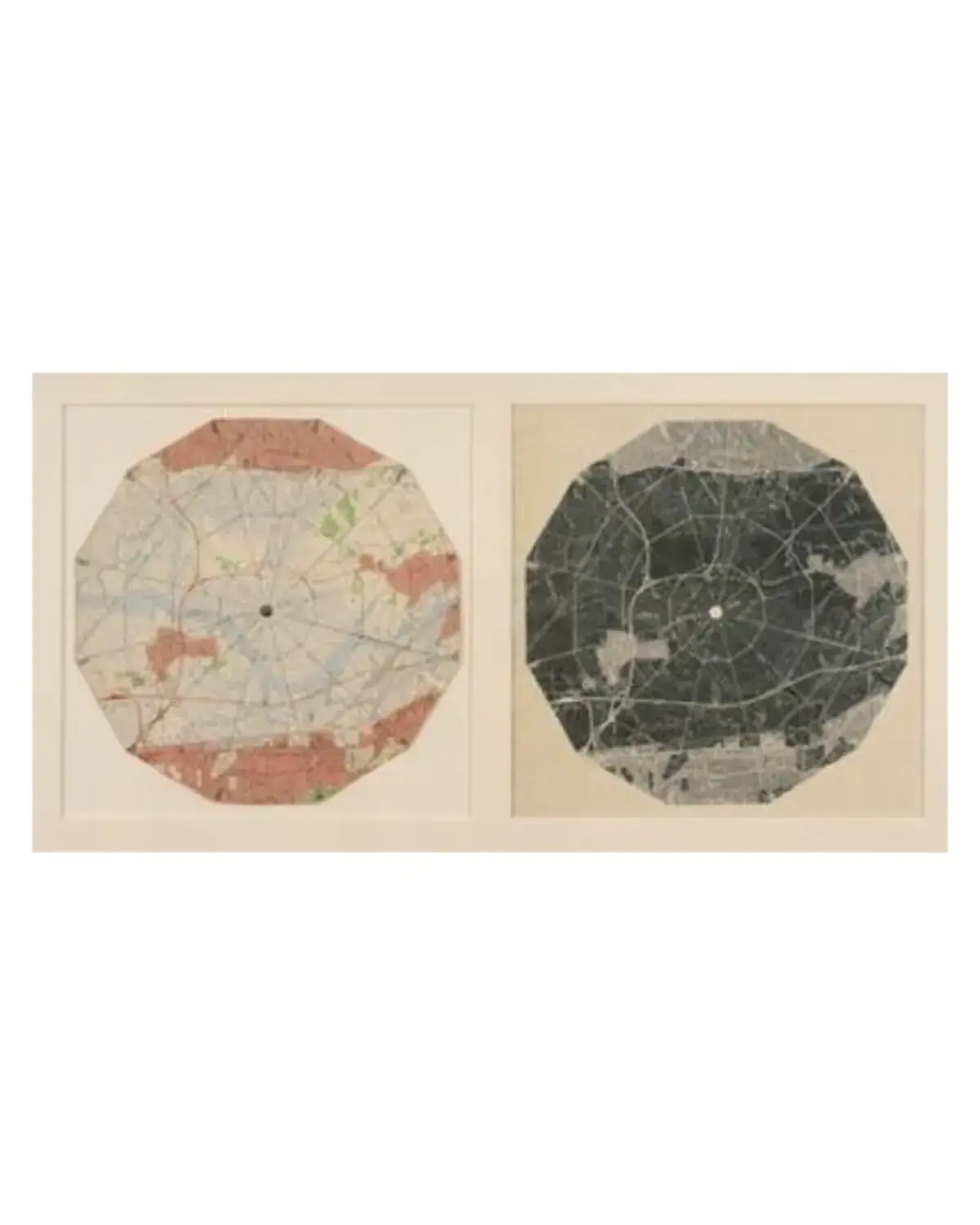
This double map documents Smithson’s “Nonsite #2,” which consisted of earth/rocks removed from a location in New Jersey, transported to the Walker Art Institute in Minneapolis, placed in boxes at the museum, and then discarded. The map therefore is effectively a double removal, evidencing the original location as well as the Nonsite’s entropic decay, the map being all that now remains at what one might call an opposite “pole” to the material. And (although here we are speculating) the opposition also seems metaphorically to be illustrated by Smithson’s using both color and black and white cartography for the site. Or as Smithson explained his theory of “nonsites” in this 1968 essay:
“By drawing a diagram, a ground plan of a house, a street plan to the location of a site, or a topographic map, one draws a “logical two dimensional picture.” A “logical picture” differs from a natural or realistic picture in that it rarely looks like the thing it stands for. It is a two dimensional analogy or metaphor—A is Z. The Nonsite (an indoor earthwork) is a three dimensional logical picture that is abstract, yet it represents an actual site in N.J. It is by this three dimensional metaphor that one site can represent another site which does not resemble it—thus The Nonsite. To understand this language of sites is to appreciate the metaphor between the syntactical construct and the complex of ideas, letting the former function as a three dimensional picture which doesn’t look like a picture. “Expressive art” avoids the problem of logic; therefore it is not truly abstract. A logical intuition can develop in an entirely “new sense of metaphor” free of natural or realistic expressive content. Between the actual site in New Jersey and the Nonsite itself exists a space of metaphoric significance. It could be that “travel” in this space is a vast metaphor. Everything between the two sites could become physical metaphorical material devoid of natural meanings and realistic assumptions. Let us say that one goes on a fictitious trip if one decides to go to the site of the Nonsite. The “trip” becomes invented, devised, artificial; therefore, one might call it a non- trip to a site from a Nonsite. Once one arrives at the “airfield,” one discovers that it is man-made in the shape of a hexagon, and that I mapped this site in terms of aesthetic boundaries rather than political or economic boundaries.”