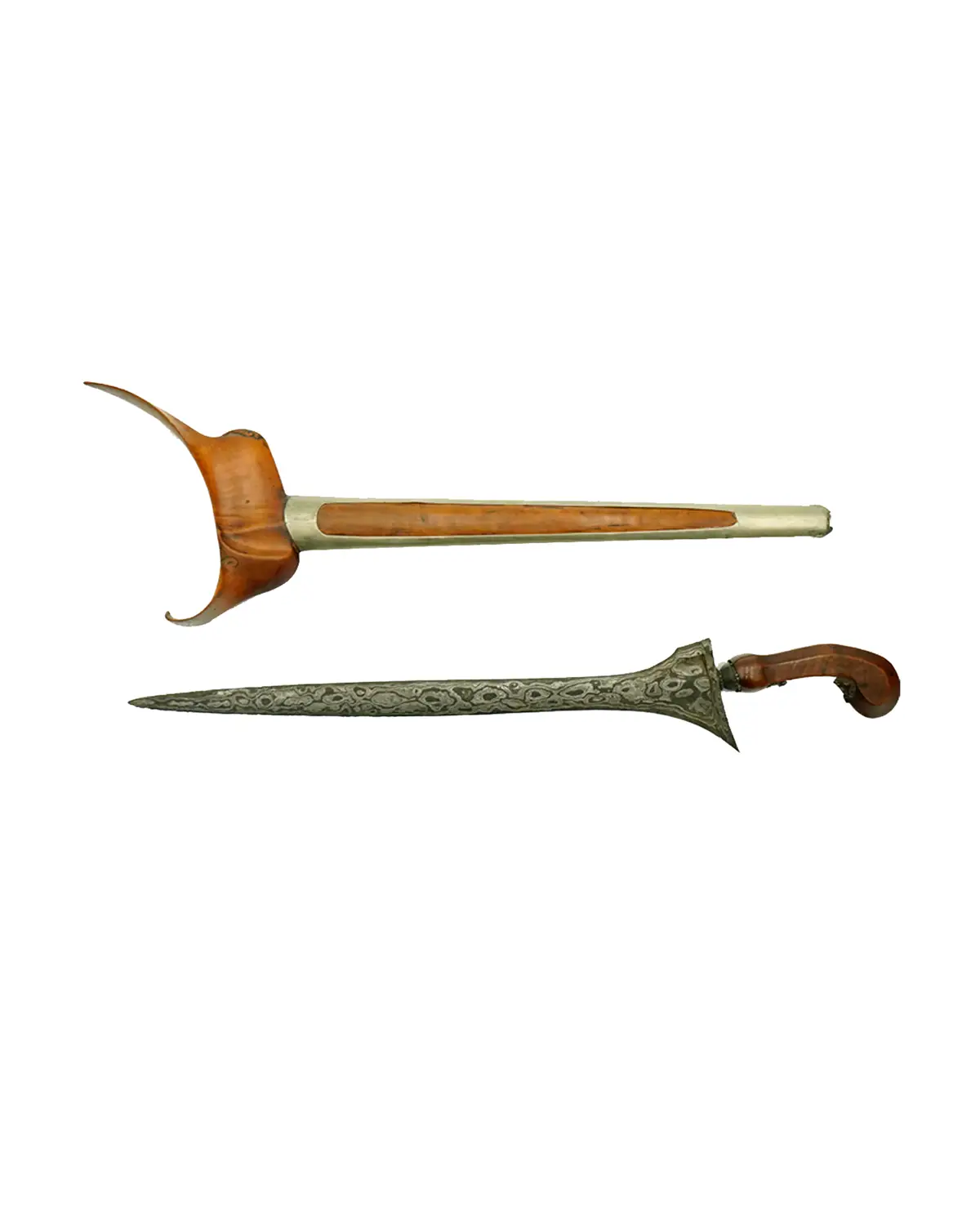
The two components presented here were likely not originally paired but instead form a complementary documentary grouping. The scabbard is from the Bugis branggah tradition from Sulawesi; the blade is a long lurus (straight) keris of probable Javanese derivation. The combination is representative of the cross-regional movement of keris components that characterizes collecting across the archipelago.
The Bugis scabbard is identifiable by its atasan: the wood divides into two diverging upswept tips, the branggah form that is one of the most recognizable regional scabbard types in the collection. The warm honey-brown wood, possibly narra (Pterocarpus indicus), is left uncarved, allowing the form itself to carry the visual argument. White metal trim strips on the gandar (scabbard grip) and a metal ferrule indicate prestige use. The lurus blade is long by Javanese standards, with a broad pronounced ganja and an elaborate large-scale pamor in swirling light-on-dark forms consistent with several named types. The simple recurved wood hilt is consistent with Yogyakarta or Surakarta practice and is the type of plain, functional hilt also seen in H10.
lurus (pronounced: LOO-roos)
Indonesian: straight. A lurus keris blade has no waves. Lurus blades are associated in the typological literature with directness, clarity, and martial effectiveness, and are at least as common in surviving collections as luk blades.