
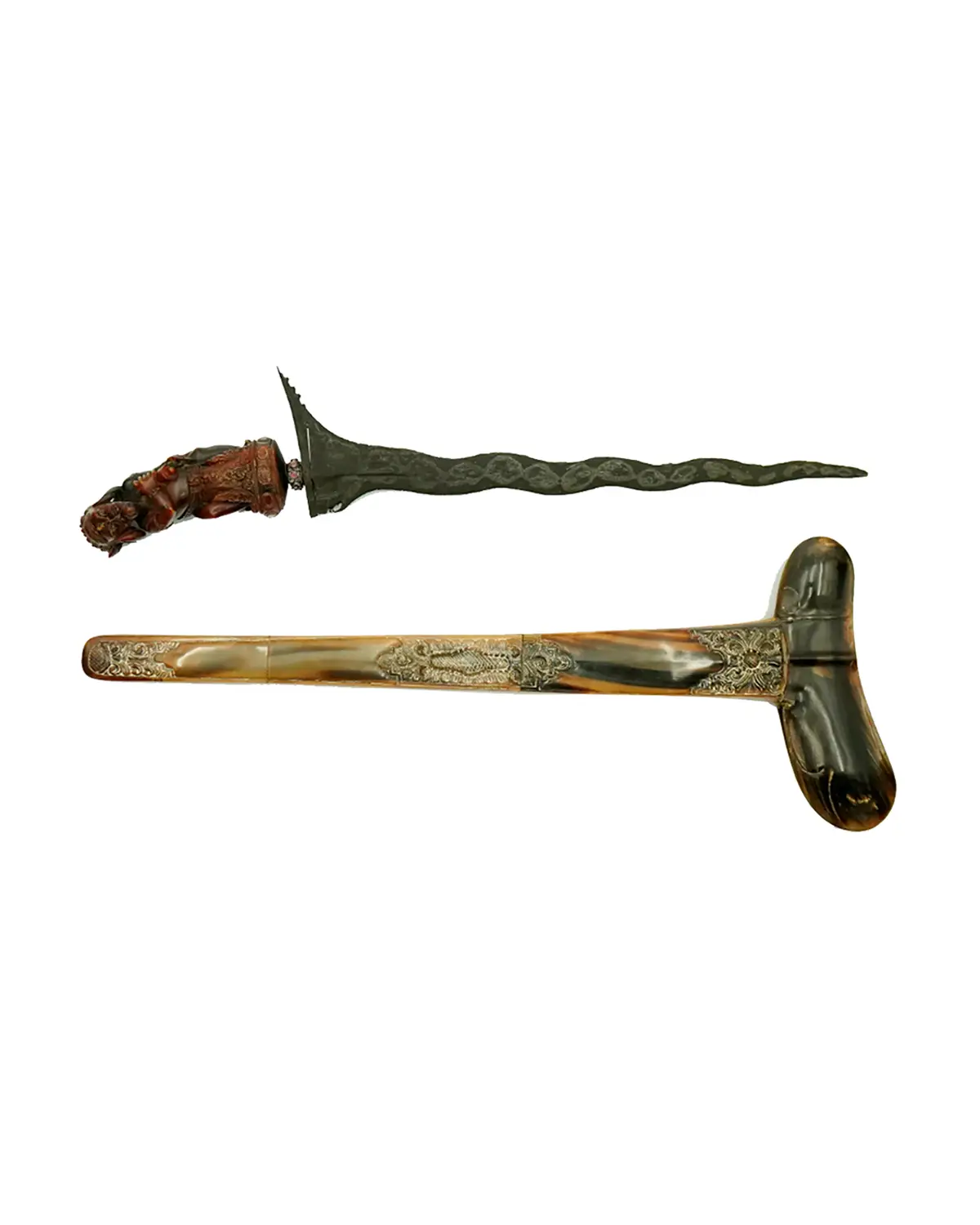
Here hilt, blade, and scabbard are present, and all three components belong to the Balinese tradition, making it a good example of coherent regional integrity. The blade shows seven waves (luk-7), associated in Balinese cosmological reading with authority and influence, with a well-developed pamor in flowing interlocked striations consistent with high-quality Balinese smithing. The bold lateral ganja (baseplate) reinforces a Balinese attribution.
The hilt is carved from a deep reddish-brown hardwood, likely sono (Dalbergia latifolia), depicting a crouching demonic figure whose bulging eyes, pronounced fangs, and multi-lobed crown identify it as a Raksasa or kala-derived protective spirit. Comparing this hilt across the collection with H08 (ivory raksasa) and the silver figural hilts H07 and H12 reveals that the raksasa iconographic type was produced across the full range of available materials and techniques, suggesting that the choice of material reflected the patron’s resources while the iconographic type itself remained constant. A comparable raksasa in the squatting posture survives in the Metropolitan Museum, in a Banten-sultanate keris of Javanese or Sumatran origin (acc. 36.25.1270a,b), evidence that the type travelled west from its Balinese and East Javanese heartland into Sumatra along the same transmission corridor proposed below for the carved horn hilt H03.
The scabbard is Balinese of the gayaman form. The broad T-shaped atasan (upper scabbard section) in black polished horn, faced and banded with repoussé silver panels depicting foliate scrollwork and kala motifs. Silver-mounted horn scabbards of this quality were produced for courtly and priestly use in Bali, and the tonal unity between blackened horn and silver mounts is a hallmark of Balinese scabbard production.