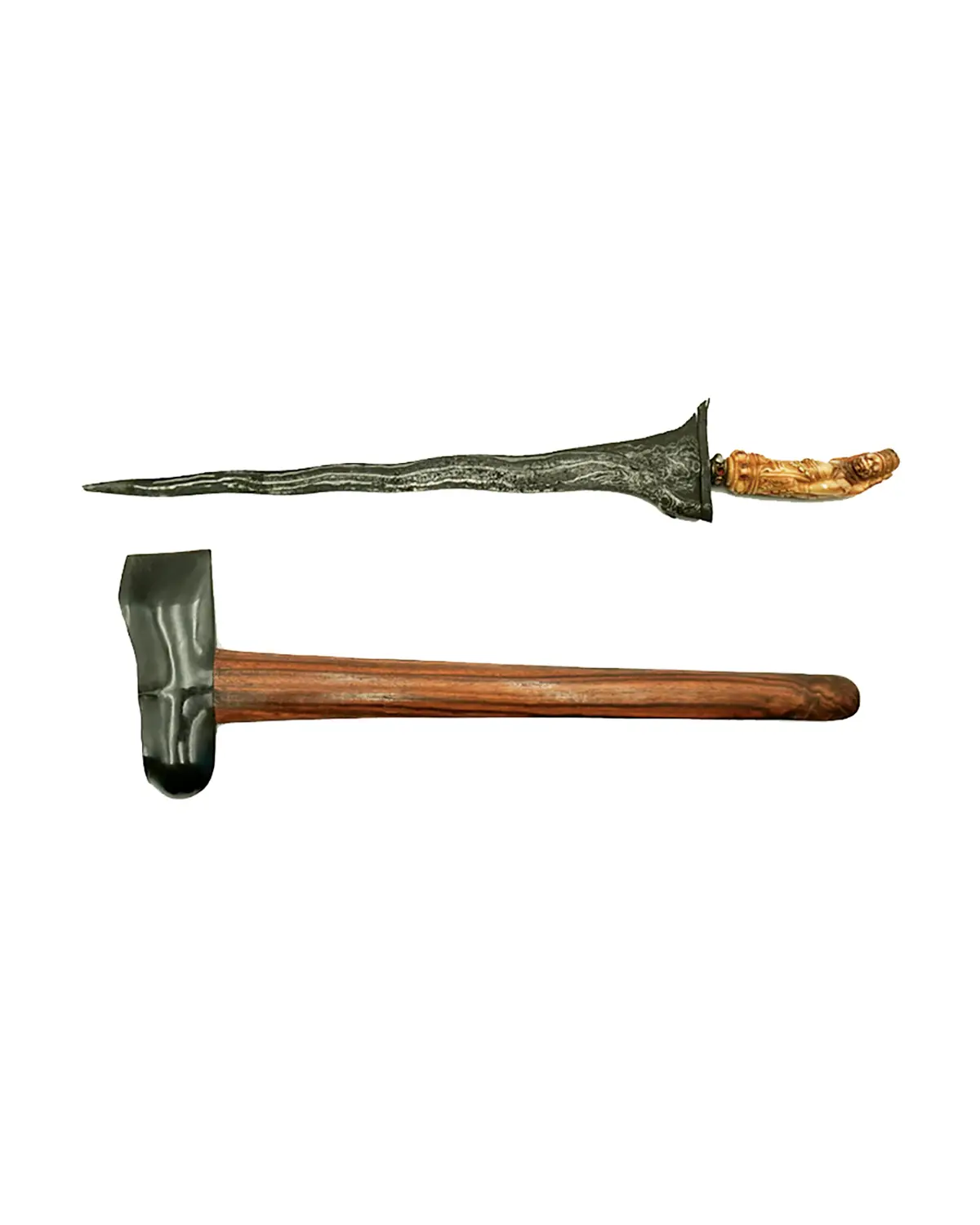
This entry juxtaposes a refined keris with an empu’s workshop implement, and suggests a sacred dimension of keris fabrication. The lurus blade carries a dense marbled pamor in flowing iron-and-nickel configuration; the narrow, closely fitted ganja is consistent with Central Javanese court production.
The hilt is a dewa form in ivory with gold-gilt applied to the crown and upper body of the kneeling or standing figure, whose attributes are consistent with Balinese Hindu iconography, likely Wisnu (Vishnu) or a related protective deity. This is the first of two dewa hilts in the complete-keris group, the second being K09. The gilding covers approximately one third of the carved surface, concentrated on the crown and upper torso, while the ivory reads as a warm cream ground. The gilt metal mendak reinforces the hierarchy of material and finish. Comparing K04 and K09 across the catalogue reveals differences in gilding coverage and figural proportion that could reflect workshop variation, chronological distance, or differences of patron specification. The instability of such identifications is well illustrated by a Balinese figural hilt in the Metropolitan Museum (acc. 36.25.1265), long read as Krishna and now more often as his companion Arjuna, where the diagnostic evidence lies less in fixed attributes than in the markers of alus refinement, the elongated eyes, serene downturned face, and composed posture that together signify noble character.
The scabbard reflects the form of a heavy smithing mallet with a rectangular iron head and a turned hardwood handle. Incised markings on the hammerhead are consistent with the tradition of investing workshop tools with protective significance: the empu forges as a consecrated practitioner, and his implements share in the sacred character of the blade.
Lurus (pronounced: LOO-roos)
Indonesian: straight. A lurus keris blade has no waves. Lurus blades are associated in the typological literature with directness, clarity, and martial effectiveness, and are at least as common in surviving collections as luk blades.