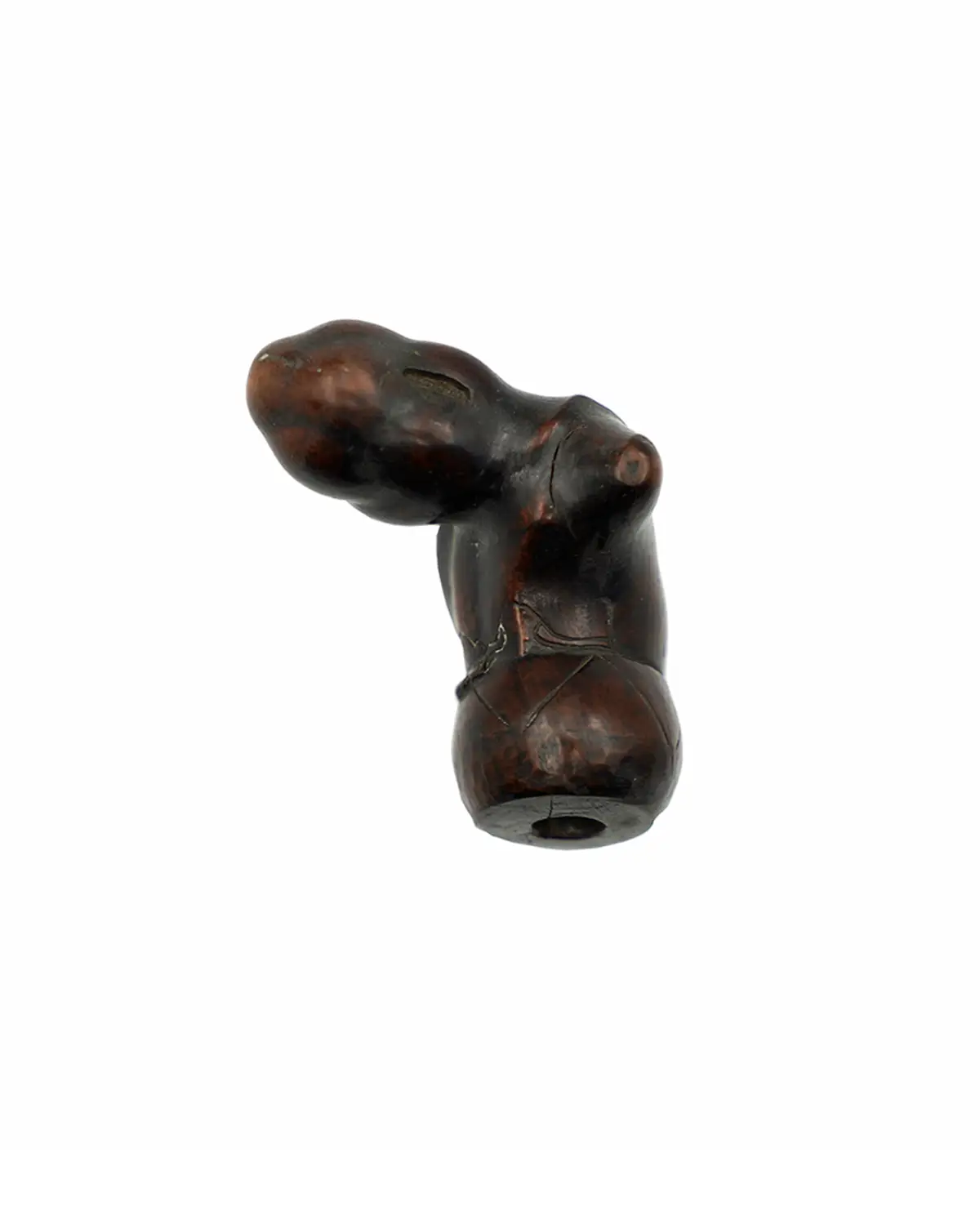
This is a figurative hilt, with the pommel being an abstracted crouching figure whose head, suggested by a smooth rounded bilobed form, projects forward in the characteristic keris-hilt manner, while the body below is reduced to a smooth bulbous waist section and a rounded mendak ball, with only minimal incised detail at the waist suggesting costume or ornament. Two small projections at the shoulder line, visible in this image, are consistent with the stylized arms or wings of a crouching figure.
This degree of formal abstraction, in which the figural reference is retained but reduced to its minimum recognizable elements, is associated with the Central Javanese court tradition, where the concept of alus (refinement, subtlety) extended to the suppression of detail in favor of pure form. The wood reads as kemuning (Murraya paniculata) or a comparable dense tropical timber with a naturally very dark color and high capacity for polish, both properties prized in Javanese court hilt production. The open blade-hole visible at the base of the mendak is clearly shown in this image, a structural detail confirming that this is a complete hilt ready to receive a blade tang.