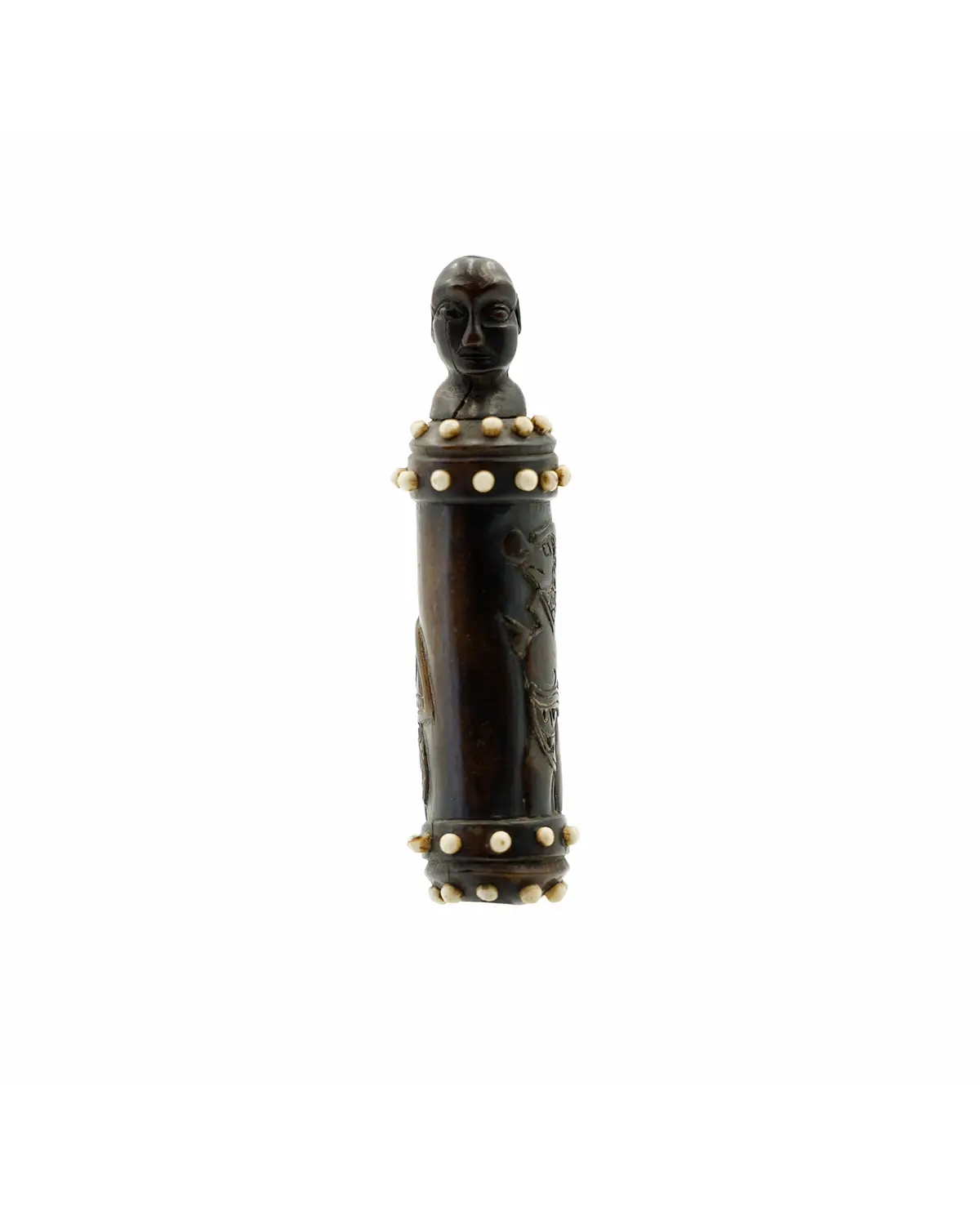
This hilt departs from the standard form in almost every respect: rather than the recurved pistol-grip ukiran of the Javanese, Balinese, and Malay traditions, it is a straight cylinder of dark wood or dense horn, proportioned more like a straight-handled dagger grip than a keris hilt. At the top, a small but realistically carved human head with naturalistic facial features (distinct eyes, nose, and mouth without the exaggeration characteristic of raksasa or dewa types) rises from a flat-topped collar. At the top and bottom of the cylindrical body, rows of small spherical ivory or bone studs are inset in the surface, creating a beaded collar effect at each end.
The combination of a straight cylindrical form, realistic human head, and ivory stud insets is entirely outside the mainstream keris hilt traditions of Java, Bali, and the Malay Peninsula. It points instead toward the traditions of the eastern archipelago, where keris production and use spread from Javanese centers but adapted to local aesthetic and ritual conventions. Possible attributions include Flores, Timor, the Maluku islands, or non-Bugis traditions of Sulawesi, all of which show in their material culture the kind of hybrid figural program visible here, drawing on both the keris tradition and earlier autochthonous carving practices. A second possibility deserves mention, since the straight grip is also at home in the Sumatran keris panjang or keris bahari, in which the handle was deliberately straightened to balance a long and narrow blade; the realistic head and the stud insets, however, point away from that mainland type and back toward the eastern islands.