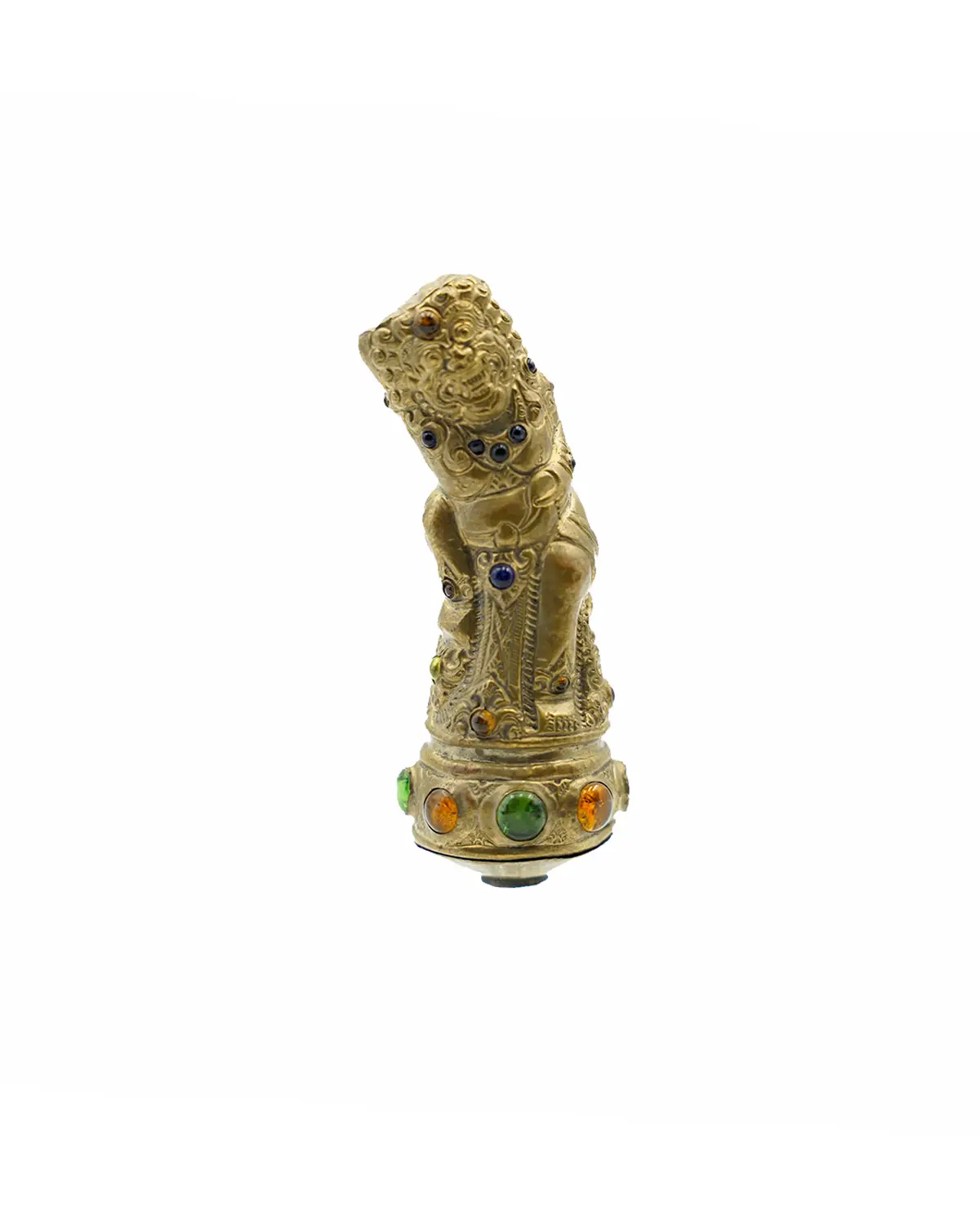
This hilt combines gilt bronze or gold-washed cast metal with an elaborate polychrome stone-setting program, consisting of blue stones (sapphire or glass), green stones (probable tourmaline or green glass), and amber stones (topaz or citrine) at the base register and scattered across the figure’s crown and body. The figure is a standing or striding demonic-divine being whose facial features and court-dressed body are consistent with a Raksasa of high rank or with the Singha (divine lion) form that appears in Balinese royal iconography. The figure stands on a domed pedestal base whose lower register carries the polychrome stone row.
This hilt type, combining a gilt cast-metal figural body with polychrome stone insets, is consistent with Balinese court production associated with the kingdoms of Klungkung and Karangasem, where the integration of jewelry-making and hilt-carving traditions was most fully developed. The stone-setting program serves both a decorative and a cosmological function: specific stones and colors carry specific planetary and protective associations in the Balinese Hindu system. A closely comparable object survives in the Metropolitan Museum, a Balinese hilt of cast gold set with semiprecious stones and turquoise depicting the raksasa king Rahvana (acc. 32.75.255a,b), whose fluid modeling is thought to indicate a sixteenth- or seventeenth-century origin for the type.
Raksasa (pronounced rahk-SAH-sah)
Sanskrit/Javanese/Balinese: a class of demonic or semi-divine beings in Hindu-Buddhist mythology. In the context of keris hilts, a raksasa hilt depicts one of these beings, typically characterized by bulging eyes, fangs, and an imposing crown. Raksasa imagery functions apotropaically, the ferocious exterior of the figure serving to frighten away malevolent spirits.