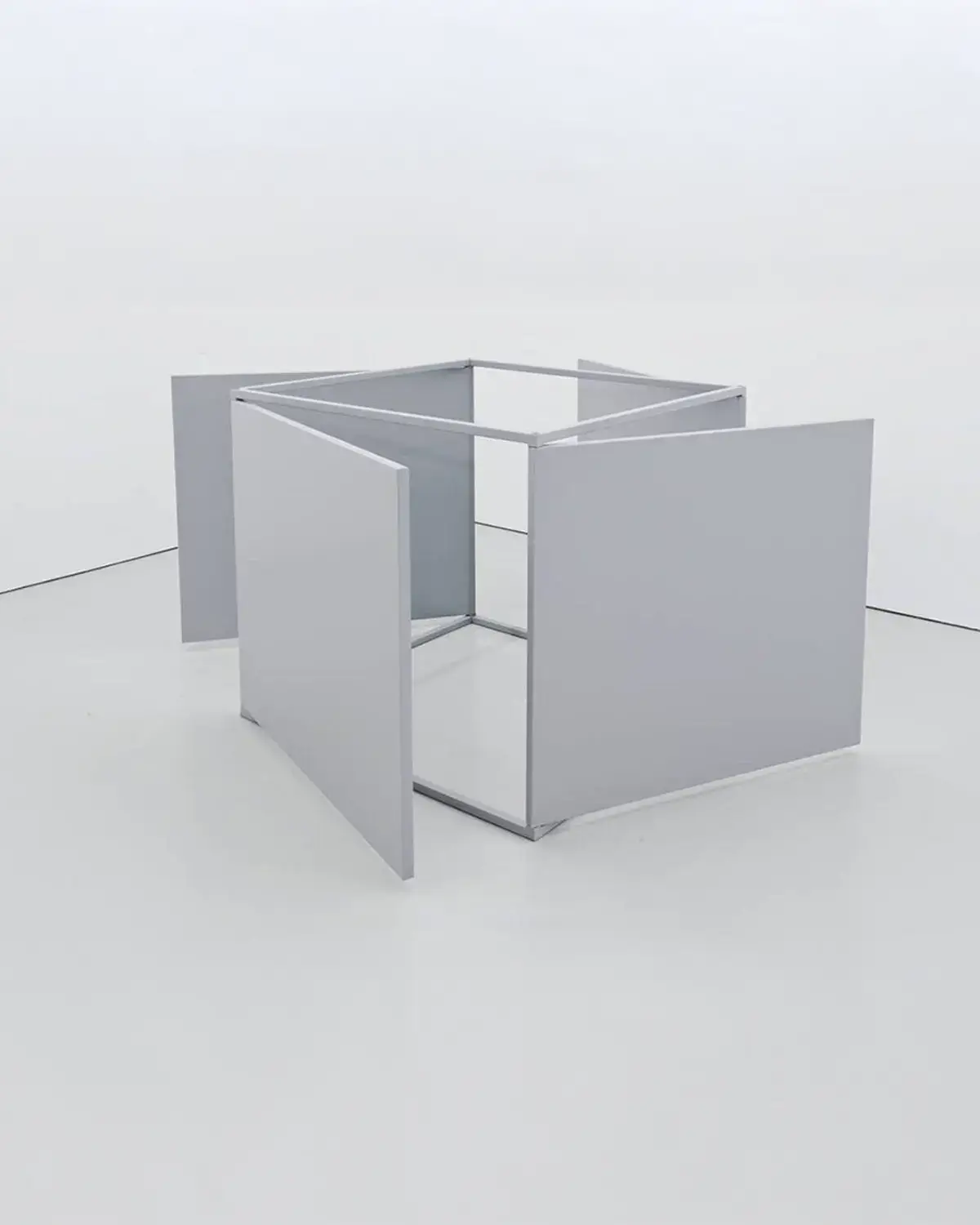
As with her “Square Tubes” (also in the Foundation’s collection and accessible on the website), this “Small Revolving Vane” from Posenenske’s E Series was realized as an “authorized fabrication” out of a theoretically unlimited series, this example being number 14/x, with the denominator only determined as of the last fabrication prior to the death of Posenenske’s executor. With Series E, Charlotte Posenenske developed a body of work that condensed her core artistic concerns: variability, participation, and the transgression of traditional boundaries of art. The revolving vane objects are not autonomous sculptures in the classical sense, but open systems that continually assume new forms through the movement of viewers. The Small Revolving Vane, a cube of 100 cm edge length, remains close to the realm of sculpture, yet the public intervenes here just as it does in the Large Revolving Vanes, where door-sized panels create passages or thresholds as they are opened and closed. Here visitors similarly rotate the walls, thereby altering the object’s appearance. Posenenske shifts emphasis from aesthetic contemplation to performative action: the work is never complete but always open to change.
At the same time, this is the last series of work Posenenske created before her radical withdrawal from the art world in 1968, when she turned to sociology and the study of social processes. Famously, she came to the difficult conclusion that art is not an effective solution in a statement that became known as her “Manifesto,” first published in Art International. The manifesto is a statement of her primary artistic principles and a farewell to the art world, claiming that “art cannot contribute to the solution of urgent social problems.” She professes that “the things I make are variable, as simple as possible, reproducible,” they can “always be rearranged,” and that this is left to the consumer “who thereby again and anew participates in the creation.”