
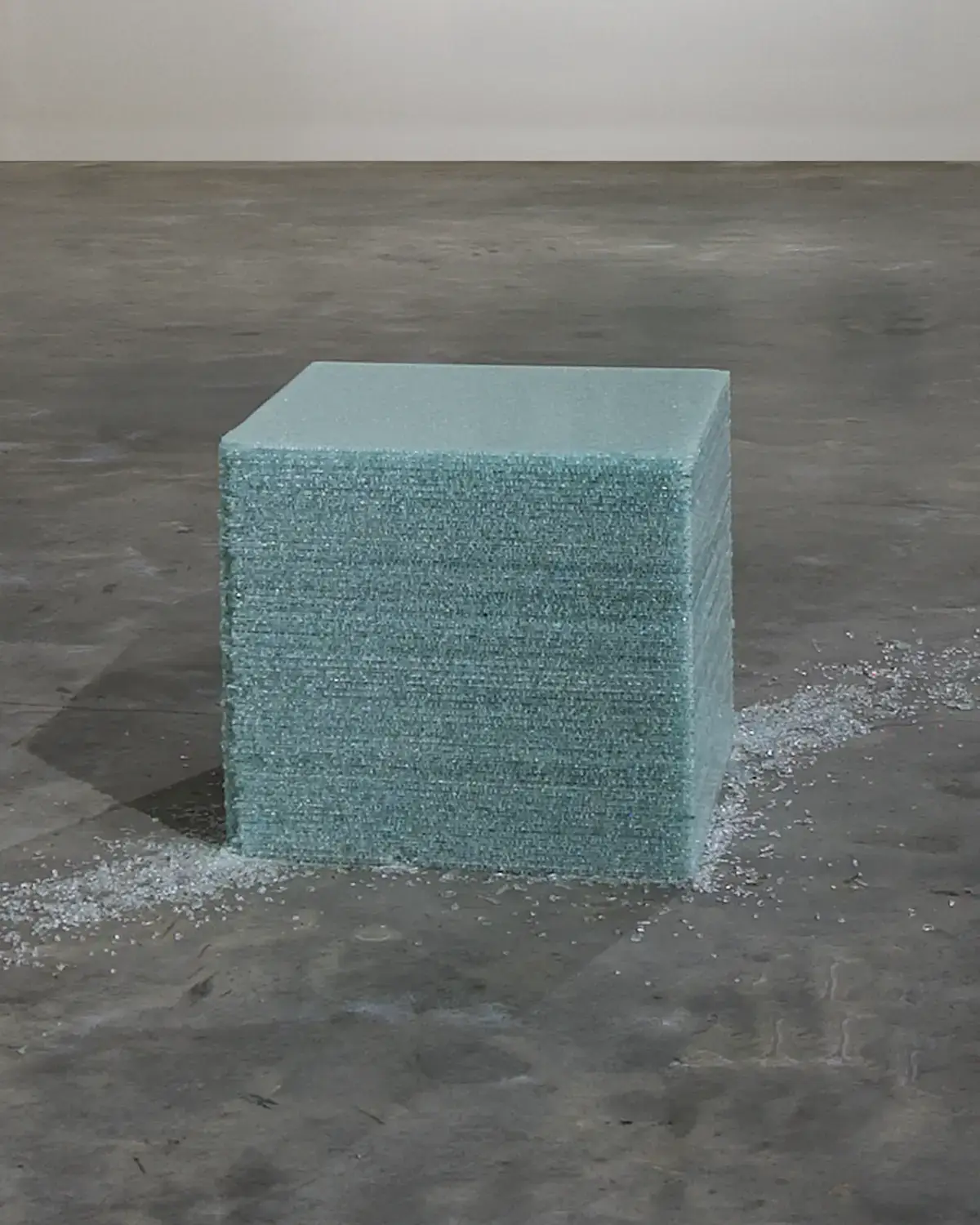
This work is one of three “cube” structures conceptualized by Donovan, consistent with her single-use take on a given material, to be constructed of toothpicks, straight pins, or in this case tempered glass. The work is evidenced by a certificate containing instructions on how to install the work and they bear quoting:
1. The individual panes of glass used to make Donovan’s glass cube are stacked one atop the other, flat on the floor where the sculpture is to be installed. The result is a dark green block of glass with the sides and edges carefully aligned. The top four sheets of glass must be completely free of dirt and smudges.
2. Two forms, each made from two square sheets of plywood joined with screws along one side (to make an “L”), are then placed around the sculpture. Because the forms are two inches shorter in length than the sculpture, two channels run vertically along opposite corners of the cube. Four people, one on each side, hold this wooden armature firmly in place.
3. Position the head of a large flathead screwdriver against the corner of the bottom sheet of glass, which is accessible through the corners of the plywood form. Sharply strike the back end of the screwdriver with a hammer until the bottom sheet of glass shatters. Then move to the opposite side and break the next sheet in the same manner, moving upward and alternating corners with each layer. During this process, the individuals holding the form must be careful to hold the plywood firmly.
4. In order to keep the top of the sculpture contained, the uppermost sheet of glass is not broken, but is removed once all the layers have been shattered beneath it.
5. The wooden panels should then be carefully removed (pulled away from the sculpture), leaving the cube shape within intact.
6. The net result is a cube of the specified dimensions held together solely by friction and gravity, to be de-installed with a broom and a large waste container and refabricated where or whenever desired using new glass.
One interesting difference between the way Donovan views such works and how some other “Conceptual” artists do is that it is of no moment to Donovan whether the work is realized/reified in more than one place at a time. Thus, when asked by the Collection’s founder whether he could lend it to someone else to install or install another version in another location, Donovan said, “You can have it installed all around the world all at once if you want, so long as it’s only 29 x 29 x 29 inches, since it still just one idea.” Contrast this with the painting-over that LeWitt or Bochner require in their certificates if a work is to be installed by same owner but in an additional location (see the entries for such works).