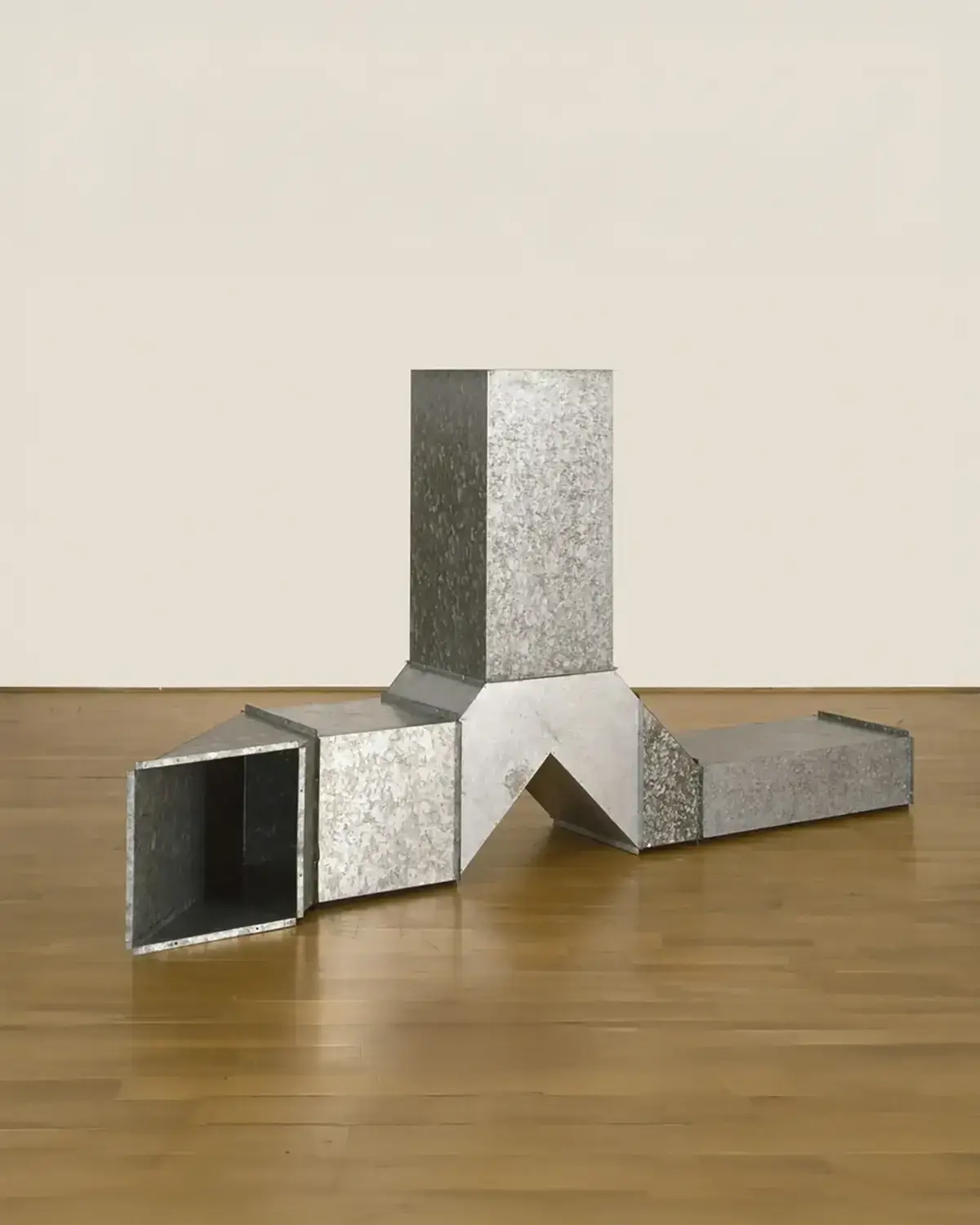
Charlotte Posenenske’s Vierkantrohre der Serie D [Series D square tubes] of 1967 is a construction set comprised of six different hollow bodies made of galvanized sheet steel: the square tube, the rectangular tube, the cubical tube, the angular piece, the transition piece, the T-shaped pipe. These basic stereometric elements, which are oriented toward volumes and direction, can be combined to create any number of configurations, which, as opposed to traditional sculpture, can basically be continued, i.e., are incomplete and variable and can adopt space-consuming architectural dimensions. These are no longer sculptures, but objects. The concept envisages a curator or buyer being able to assemble and change the installation according to his or her own criteria, which involves the artist relinquishing part of her creative authority to others. The configurations can be presented standing, lying, hanging, in series, systematically, or as one sees fit (combinations of any and any number of elements) – both indoors and outdoors. Beginning in 1967, the elements were factory reproduced as authorized reconstructions in a theoretically infinite series, with the price specified not to exceed the actual (and thus modest) cost of fabrication, plus a small fee for the gallery. By insisting on unrestricted reproducibility, limited only by the open-ended number of persons interested in buying the works, Posenenske was attempting to undermine the claim to originality and exclusivity associated with one-of-a-kind objects as well as to demonstrate the artificiality of both primary and secondary market prices. That said, her widower/executor determined not to have the authorizations continued after his death, such that when that occurred the infinite denominator of the editions became finite, thus further proving her point by giving rise to a secondary market that wouldn’t otherwise have existed.