
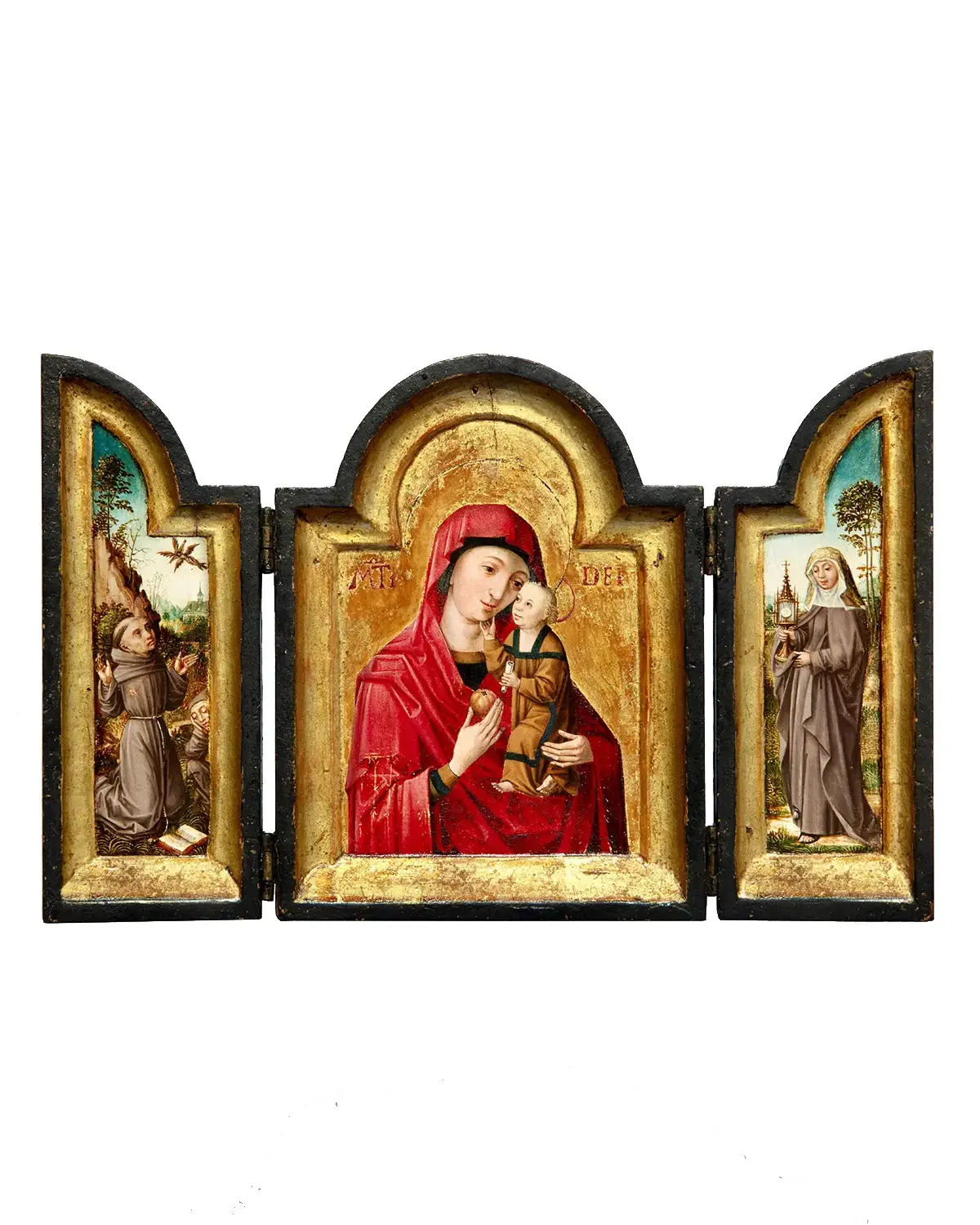
The Master of the Embroidered Foliage (active c. 1480 – c. 1510) is the Notname for an Early Netherlandish painter or a group of painters who worked out of Bruges and Brussels. The art historian Max Jakob Friedländer attributed a group of paintings of the Virgin and Child in a landscape and in identical poses to the “Master of the Embroidered Foliage”. The foliage painted in these works was likened by Friedländer to the repeated pattern of stitches in embroidery, thus the unusual name for the artist. His (presumably) paintings show elements of previous works by Rogier van der Weyden and Hans Memling.
In the central panel of this small triptych, the Virgin is shown at bust length occupying an otherworldly space entirely coated in gold. She is depicted wearing a red mantle or maphorion which covers her hair and wraps loosely around her shoulders. Her infant son wears a full-length garment, its large main panels utilizing umber cloth with linear detailing in the form of broad bands made across the shoulders, shins and thighs in blue. He appears to ignore the apple – commonly considered as a symbol of his identity as the new Adam – which his mother tries to present it to him with her right hand. An inscription in two parts, each comprising three letters picked out in red pigment, appears against the gilded backdrop on either side of the Virgin’s head. Its phrases can be read as ‘MTR’ and ‘DEI’, to be read therefore as ‘Mater Dei’ or ‘Mother of God’.
Bookending the central panel on each wing are three figures appearing in Franciscan habits tied at the waist with knotted cinctures. On the left wing, Saint Francis kneels in three-quarter profile, turning in to the central panel but gazing up towards a small image of a winged Crucifix which appears miraculously in the sky above him. He is shown at the very moment in which he is said to have received the Stigmata. His companion, Brother Leo, is fast asleep with his head on his hand in the lower right hand corner of the scene, while the saint’s refuge or hermitage can be seen rising from the landscape behind him. The same arcing horizon line depicted behind Saint Francis is continued on the right wing, uniting the two spaces despite the interruption of the gilded backdrop on the central panel. Standing in the foreground is the figure of Saint Clare of Assisi, one of Francis’s most important disciples and the founder of the Clarissan Order, also known as the ‘Poor Clares’. She has lifted the edge of her mantle with the fingers of her left hand and uses it to carefully cradle and protect the base of a tall golden monstrance, which she also grasps with her right hand for good measure. According to her vita, the saint repelled the marauding armies of Emperor Frederick II, using only a monstrance in which was displayed the consecrated Sacrament. Here the white disc of the Host appears within a protective cylinder of glass or rock crystal at its center, the container’s surface flashing with reflected light.