
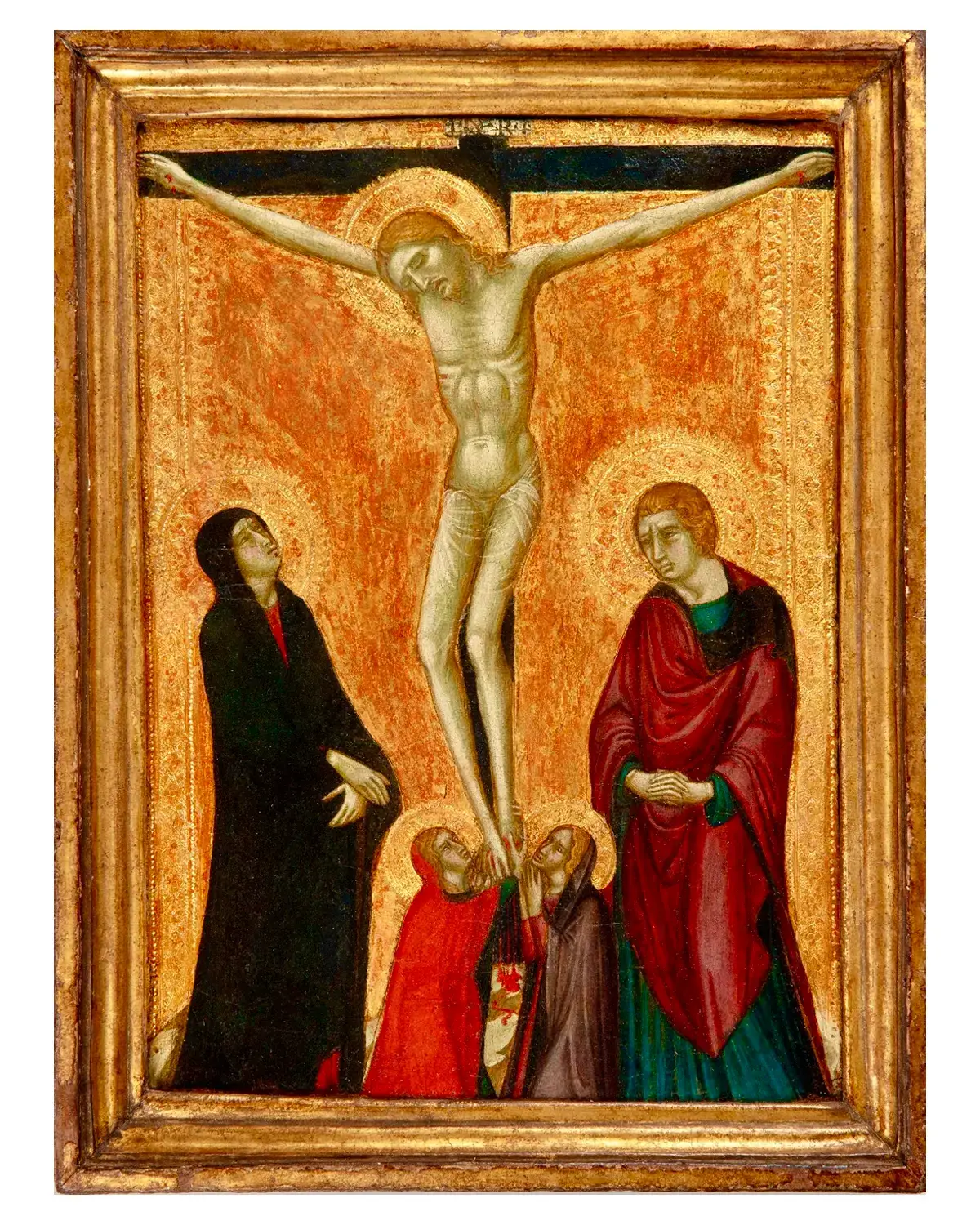
This intense, emotive Crucifixion scene was painted by an as-yet unidentified artist deeply influenced by the great Sienese painter Duccio di Buoninsegna (1255-1319). He has possibly chosen to model the image on an earlier prototype, that perfected in Duccio’s Maestà, installed on the high altar of Siena’s cathedral in 1311, but would have done so by paring back Duccio’s populous grouping of figures to leave only the essential protagonists in place. He has traditionally been thought of as a close follower of Duccio, and some scholars surmise that he worked as a young apprentice in Duccio’s workshop. That said, much of the Monte Oliveto Master’s style in painting human figures evokes the stiff, rigid poses of Duccio’s follower, Segna di Buonaventura. As Emma Kronman suggests in an essay on the artist’s works in the Lehman Collection, he may therefore be understood not as a direct follower of Duccio but of his pupil Segna. The artist has been given the provisional name “Master of Monte Oliveto’” after a tabernacle representing the Madonna and Child Enthroned with Saints and Angels, formerly in the monastery of Monte Oliveto Maggiore near Asciano, to the south of Siena. His years of activity run from about 1315 to possibly the mid-1330’s. His style is recognizable from his use of white highlights to indicate features such as lips, noses and brow lines. The gilded background with its profuse punch work is a key factor in dating this work in the third decade of the century, in that punch tools were only popularized in Siena after circa 1320, when Simone Martini used them extensively throughout his Maestà for the Palazzo Pubblico. While his work shows a mixing of older and new prototypes, Kronman also writes that it would a mistake to view him as a mere copyist: “The Master of Monte Oliveto’s works are lively, tender, and innovative in their details. On close examination, viewers will instantly recognize how evocative and emotional his pictures can be even when they have been copied from earlier prototypes. Overall, the pictures reveal an artist with a refined sensibility who, though not an innovative genius, was certainly a gifted member of the Sienese school.”