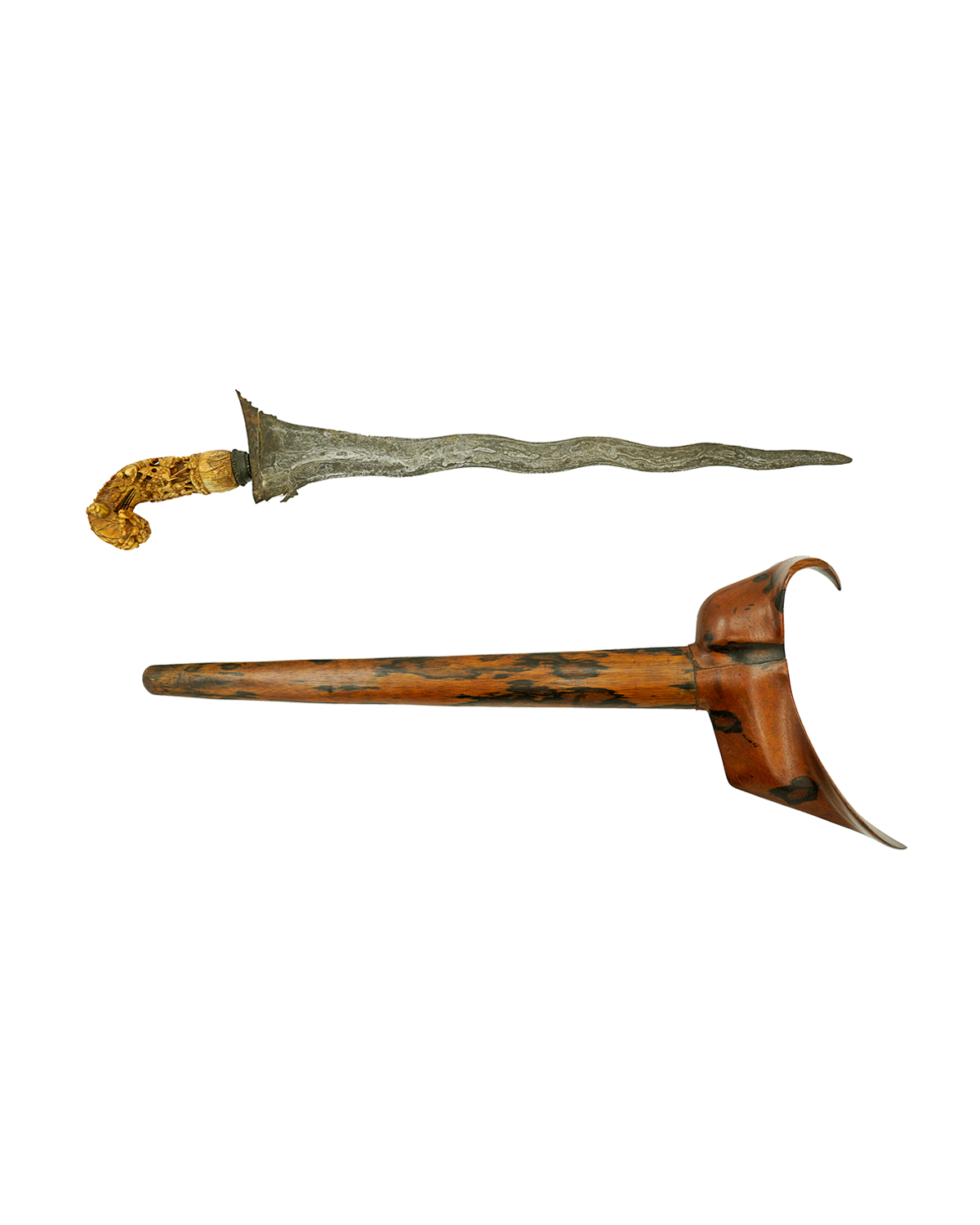
This entry is coherently Balinese across blade, hilt, and scabbard, and together with K02 provides the collection’s two most fully integrated Balinese ensembles. The luk-5 blade carries a flowing large-scale pamor in long, nearly horizontal bands of nickel-rich material against dark iron, consistent with several Balinese pamor types; the surface texture suggests regular treatment with warangan in the traditional manner. The ganja is clearly defined with the characteristic Balinese asymmetric projection.
The dewa hilt is the second such example in the complete-keris group and merits comparison with its counterpart in K04. Both depict a crowned and forward-leaning divine figure in ivory with applied gilding, both consistent with representations of Wisnu or a related Balinese protective deity. In K09 the gilding appears to cover a higher proportion of the carved surface, extending further down the figure’s body, and the overall form is slightly more compact and rounded. These differences could reflect workshop variation, a chronological gap, or differing patron specifications.
The scabbard is a Balinese or Lombok single-hook wrongko form in mottled timber with natural dark figuring, the single recurving atasan hook an elegant and confident form. The plain cylindrical gandar maintains the understated quality of the woodwork.
Luk (pronounced LOOK; Javanese: /luk/)
The wave or bend in a sinuous keris blade. Luk counts are always odd in a well-made keris, and the count runs from three to thirteen in the classical typology. Each count carries specific cosmological associations: three luk is associated with fire and passion; five with protection and stability; seven with authority and influence; nine with spiritual power of the highest order; thirteen with completion and transformation.