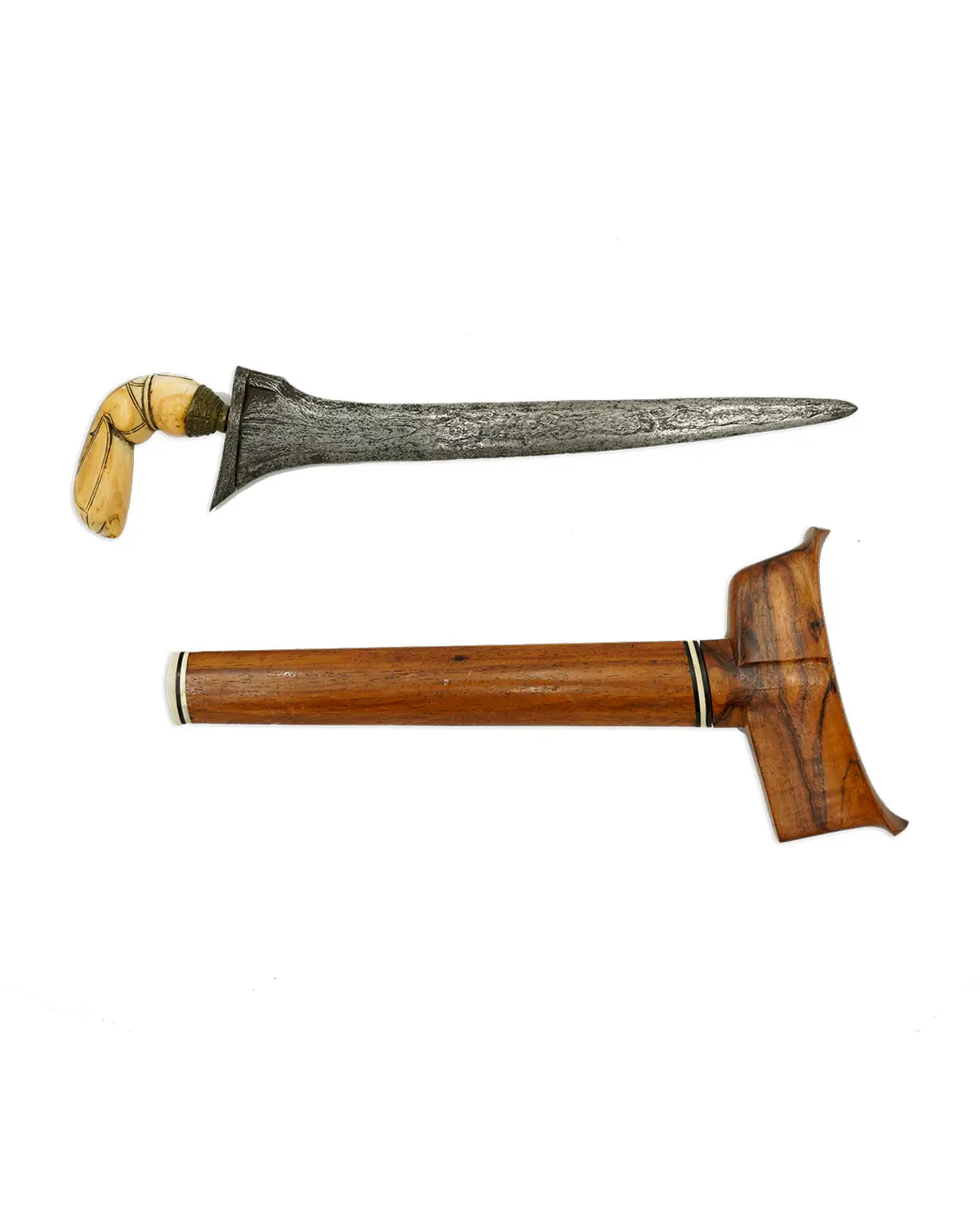
This entry brings together a blade and scabbard of fine Javanese craftsmanship within a broadly Central Javanese aesthetic framework that prizes restraint and material coherence over figural elaboration. It stands at the opposite end of the hilt-ornament spectrum from the Balinese figural entries.
The lurus blade carries a large-scale, boldly patterned pamor in which the nickel-rich material forms broad swirling clouds against the dark iron ground, consistent with named types such as awan-awan (clouds) or related large-scale formations associated in the typological literature with calm authority and leadership. The ganja is broad and well fitted. The hilt is ivory with incised line decoration in a geometric vocabulary and a small brass mendak with fiber wrapping. There is no figurative carving: the ivory itself, with its natural color and linear incision, is the decorative statement, an approach that aligns this hilt with H01 among the plain-material group within the H series.
The scabbard is a fine Javanese gayaman: the broad flat-topped T-shaped atasan in two-tone figured hardwood (likely sono or trembalo), with ivory spacer rings at the junction of atasan and gandar. The ivory rings establish a material dialogue between the hilt and the scabbard that the plain figured-wood body alone would not achieve. The cylindrical gandar continues in the same figured wood.
Lurus (pronounced: LOO-roos)
Indonesian: straight. A lurus keris blade has no waves. Lurus blades are associated in the typological literature with directness, clarity, and martial effectiveness, and are at least as common in surviving collections as luk blades.