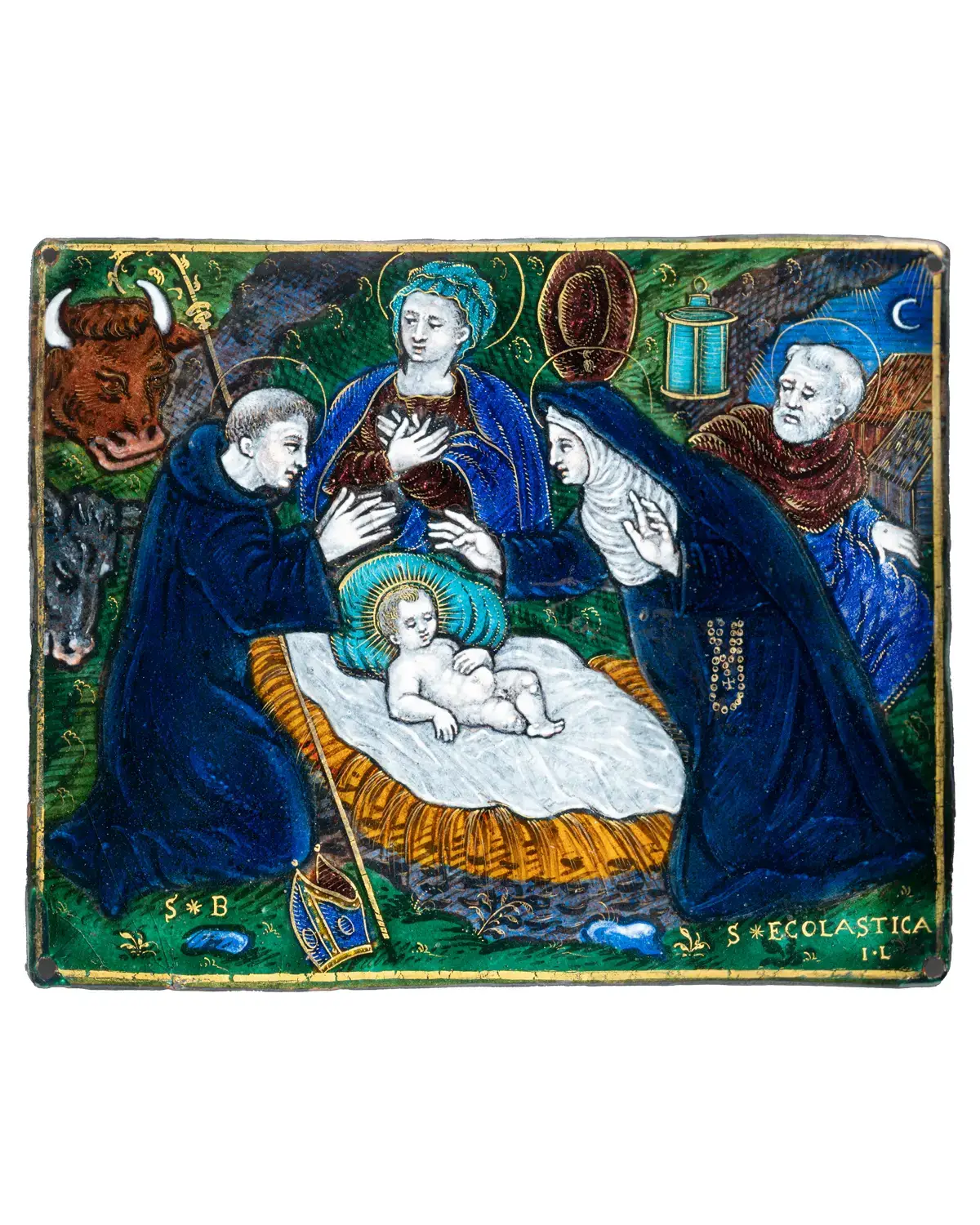
This unusual nativity scene has the 6th century twin brother and sister saints, Benedict and Scholastica, each being founders of monastic orders, shown together in the Biblical setting along with Joseph and Mary.
Just a comment here on the medium (seen also in other of the foundation’s works by the same artist), which required extraordinary technical as well as artistic ability. Enamels are created by fusing powdered glass to a copper sheet. Metal oxides are added to the clear, molten glass to produce a variety of colors, which are affected by both the composition of the glass and the concentration of the metal oxide used, as well as the atmospheric conditions in the kiln. Enamels are fired multiple times, requiring enormous skill to control the different temperatures necessary for the various colors and layers. Techniques developed during the fifteenth and sixteenth centuries permitted a wider range of opaque and translucent colors. Enamelers increasingly exploited the overlay of one color on another in thin layers or, with subtle shading, manipulated them to reveal what lay beneath. For instance, to achieve a more naturalistic flesh tone, early enamelers sometimes applied mulberry beneath the white to create warm undertones. To enhance details in the composition or delineate features in the face, a technique known as enlevage was employed, in which white powdered glass was manipulated with a fine tool to expose the darker fired layer beneath. Grisaille was also used to produce subtle modeling in shades of gray. Final touches of oxide color or gilding, brushed on and lightly fired, added expression and richness.