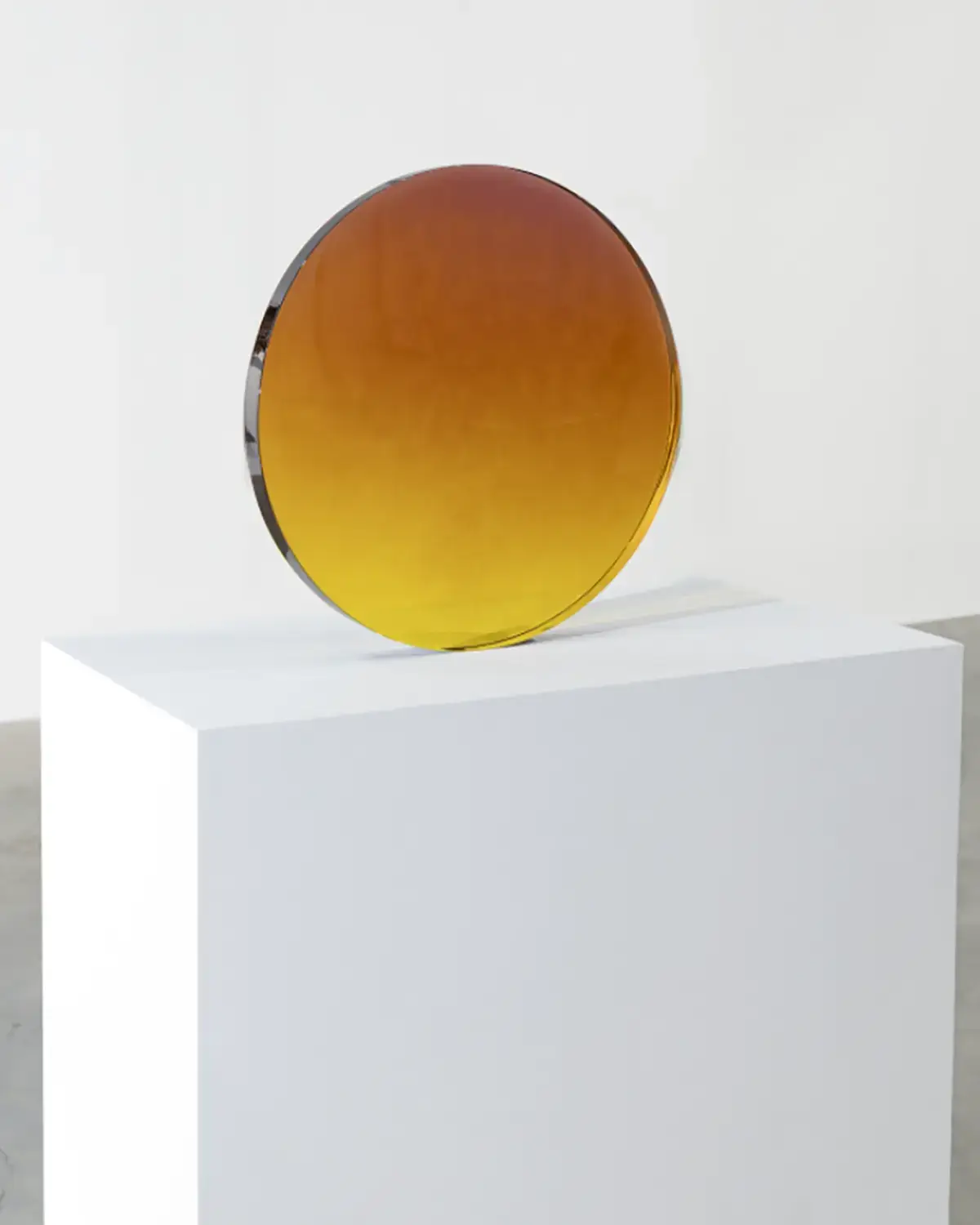
By the time De Wain Valentine moved to Los Angeles in 1965, he was already working with plastics. He had been introduced to them by his junior high shop teacher after the then-recent military declassification of the material following World War II and had been working with them on a small-scale ever since. Valentine is quoted saying that his series of polyester resin sculptures, like this circle, are “all about the sea and the sky” and that being in Los Angeles allowed him to see “a new avenue to make sculpture that was completely atmospheric or like a chunk of the ocean cut out.” His translucent circles, columns, curved slabs, and sometimes UFO-shaped disks, come in a wide array of colors, from warm rose and orange or as here, subtle gradations of golden hues.
“Finish Fetish” is another category employed to characterize the production of artists such as Valentine who are also thought of as the Light & Space group. As Joachim Pissarro noted in a catalog entry for a show of Valentine’s, “the term alludes to the embrace of new industrial technologies, surface slickness, and glossy, attractive colors. This love for the shiny, spruced up quality of the slick surfaces offered a common syntax to these artists, but spoke far more to the ubiquitous Southern California’s surf and automobile culture, than to the search for perfection that characterized East Coast Minimalism (conjuring industrial, mass production of geometric structures in perfect line with each other), whereas Valentine’s surfaces are the result of painstaking physical act of sanding, and polishing an initially rough resin surface into a perfectly glass-like smooth surface).”