
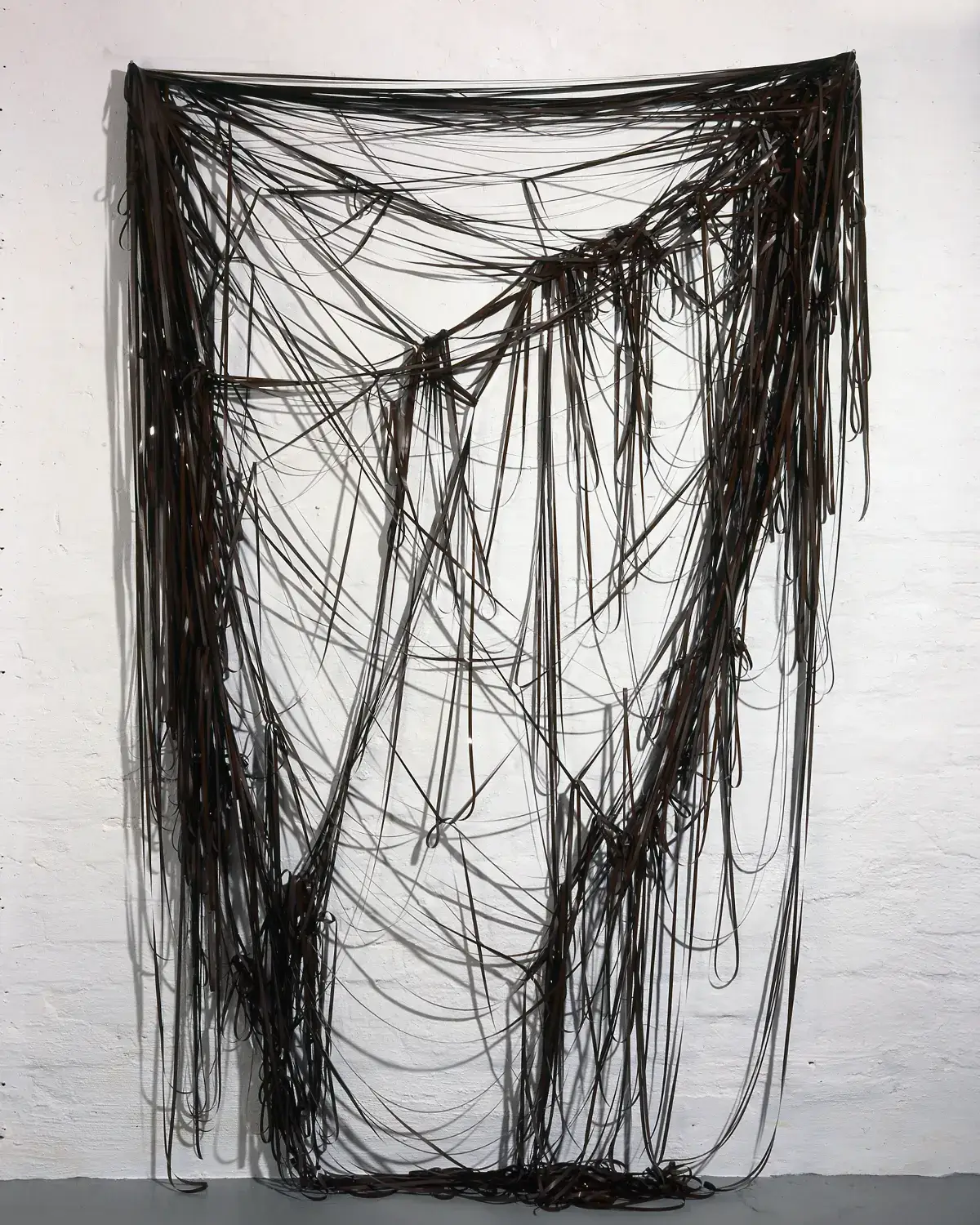
Anastasi’s installation instructions on the authenticating certificate for this work read simply as follows: “a tape recording of Beethoven’s Fifth Symphony in C Minor, opus 67, hung from wall to floor on two nails at 64 inches height by 64 inches apart, determined by the artist’s outstretched arms at eye level.” The installation can be done by the certificate holder, regardless of the originating fact that the dimensions are based on the late artist’s own height and reach. This is consistent with Anastasi’s fundamental understanding of the distinction between the concept of a work of art and the realization of that concept. His personal motto was “travel light,” meaning that carrying his thoughts with him, he could assemble an exhibition anywhere, using the materials then available at a given location, i.e., whatever particular form of nails, audio tape, bricks, paint, steel plates and so on might be at hand, permitting installation/de-installation/re-installation on a continuous basis over the course of indefinite time, with only the underlying concept remaining constant. In order to memorialize that understanding, Anastasi and Aardt’s founder executed a “Joint Statement” at the time the latter acquired the right to realize this work in the absence of the artist, in which they adopted the observations of Fred Sandback concerning the re-placement or reconstruction of his works in accordance with instructions accompanying such works: “Even when [I am] re-placing the piece in its original location, I have a Heraclitean distrust of its actually being identical with the original. But as often as not, a change of place will occur, necessitating in most cases a change of form. I give myself plenty of breathing room when approaching these adaptive changes, and enjoy the possibilities of variation. When I am not involved in a re-construction, however, my interpreter should allow herself the same freedom of movement. Is the authenticity of the original thus sullied? I don’t think so. Whenever a painting, for example, is seen, it is re-constructed according to the new vision and principles of the spectator. The re-animator in this case simply has some grace notes at her disposal.” (Emphasis in original).