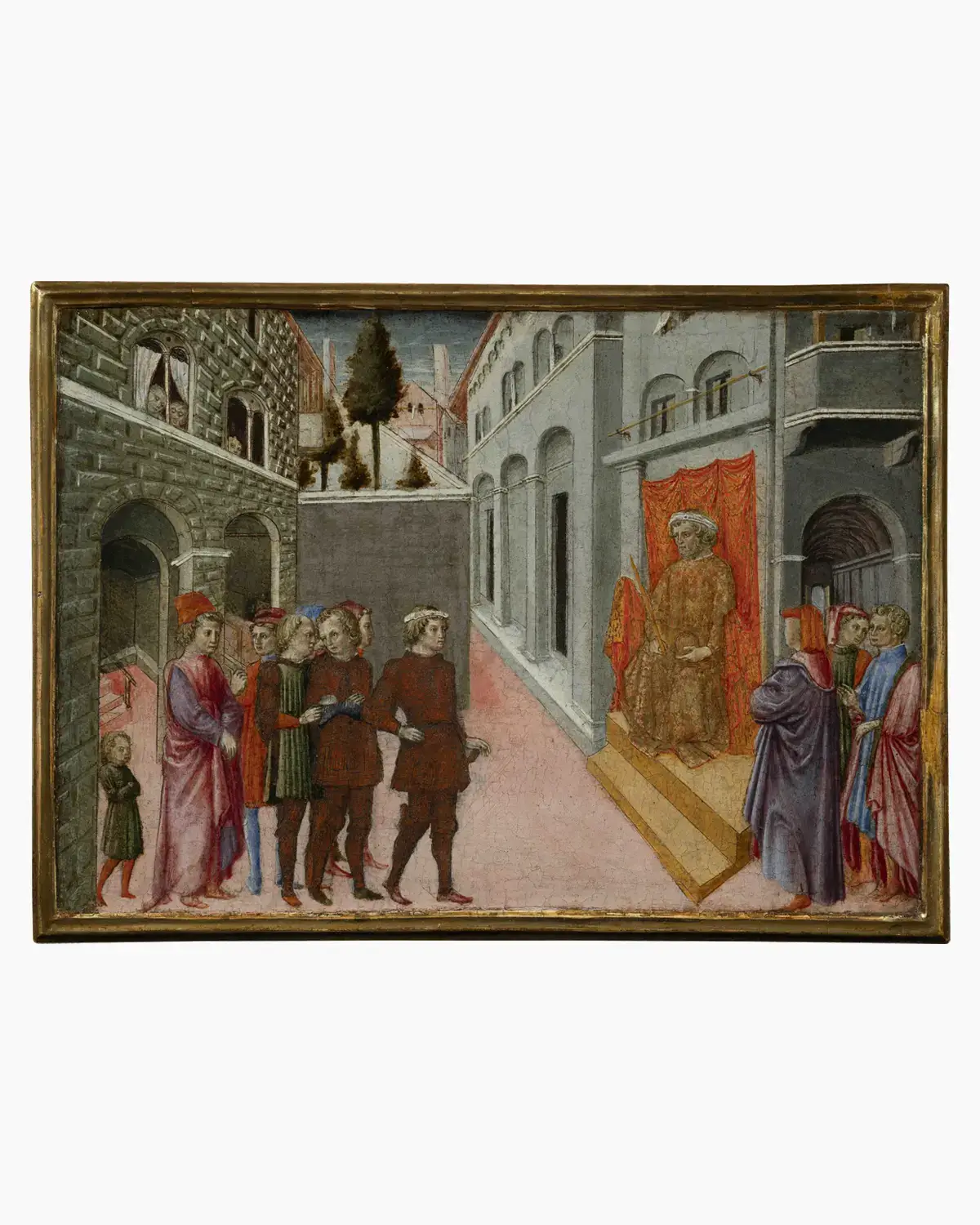
The painting depicts an embassy in front of a bearded king enthroned outside a palazzo situated at the edge of a narrow road of a city, which recalls those of Siena. He welcomes a group of high-ranking officials and counsellors headed by a young knight who, the same as the bearded king, wears a white scarf. The painting is part of a series of five panels which might have belonged to a chest or – less likely – adorned the painted doors of a wardrobe. The scenes narrate critical historical episodes of the history of Siena and the bearded king is the Holy Roman Emperor, King Sigismund, his distinctive also visible in Domenico di Bartolo’s marble inlay of the floor of the Duomo in Siena. This allows dating the scenes to Sigismund’s residence in Siena in 1432-1433 during the war with Lucca. The King sits enthroned outside in front of a palazzo situated at the edge of a narrow street of a city, which recalls the roads of Siena. He appears with a group of high-ranking officials and counsellors. A young knight followed by a group of knights and high-ranking officials has approached the King and seems to deliver him a message by the Sienese authorities. He can be identified as Antonio Cecco Rosso Petrucci, here perhaps discussing with the King and his royal councilors – among them Brunoro and Bartolomeo della Scala, Matko Talloc and Jovan Talloc – the next steps to be taken in the war with Lucca. The work is notable for its experimental use of perspective both in terms of the positioning of the figures as well as the extreme angularity of the buildings, aspects that reflect the influence of the artist’s working with Masolino on the frescoes of the Brancacci Chapel, where he would have also be alongside a young Masaccio. In that connection the functionary represented from behind in Vecchietta’s painting seems to be a quotation of the figure of the tax officer in Masaccio’s fresco ‘the payment of the Tribute” – an innovative figure, art historically important in the rendering of a natural, human space.