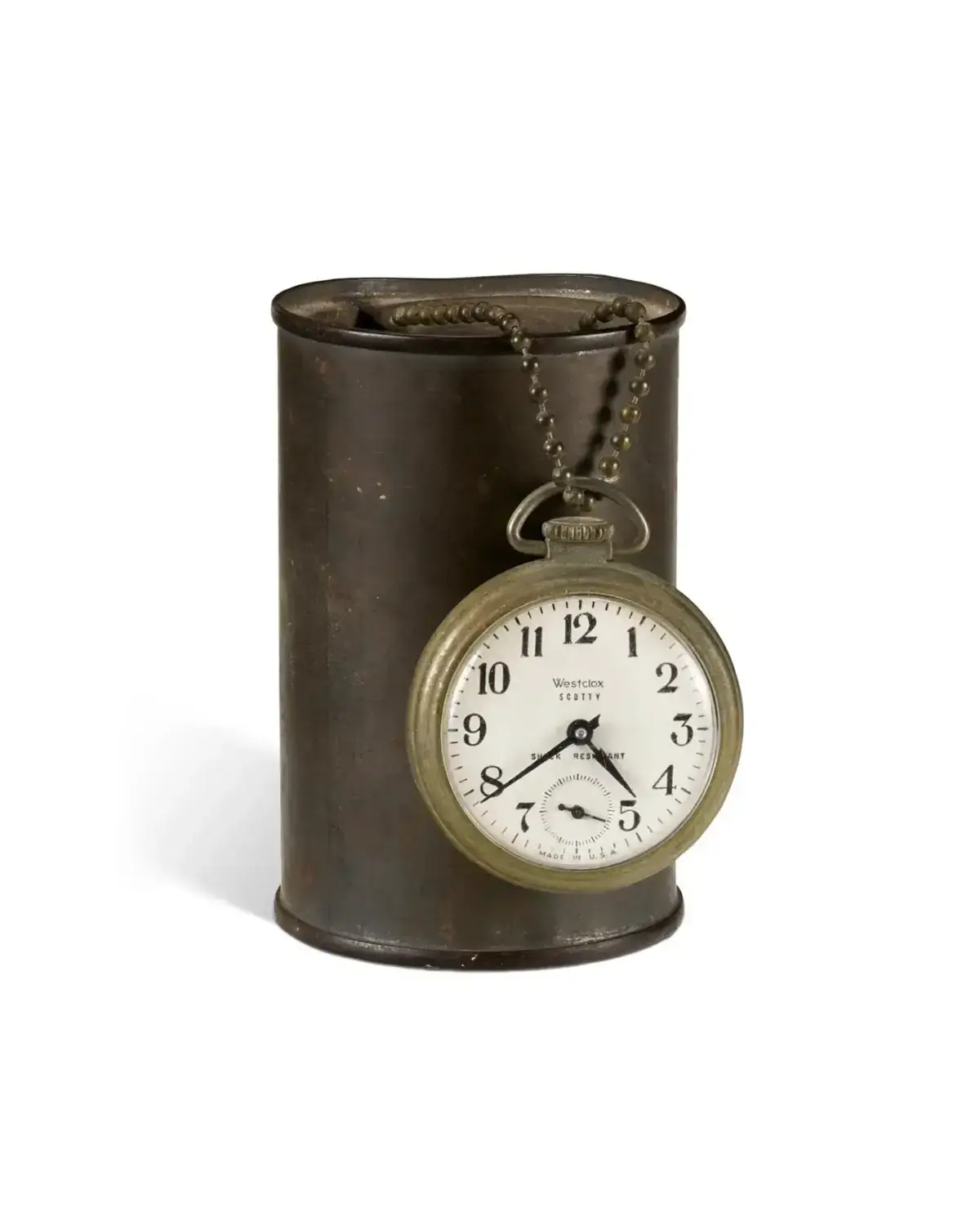
As the name suggests, the Combines are hybrid works involving assemblage of a wide range of objects taken from everyday life. In the wake of the invention of collage by Braque and Picasso, as well as that of Dadaist assemblage, Rauschenberg reinvented these practices, giving them new impact in his Combines. A child of Dada, Rauschenberg was influenced by the assemblages of Kurt Schwitters, whose example led him to suggest that art and life are but one. Nevertheless, as Barbara Rose has pointed out, Rauschenberg’s art drew its inspiration from the America of that era, and the artist was reacting against Abstract Expressionism and its goal of the absolute when he incorporated images from magazines or non-artistic materials into his works. (Interestingly, Rose herself formerly owned this work – it had originally been gifted to her former husband Frank Stella by Rauschenberg, and Stella in turn gave it to her). Citing an artist whom he viewed as a profound influence, Rauschenberg pointed to da Vinci’s Annunciation (1475-1478) at the Uffizi Gallery in Florence. “Since his painting is life, the tree, the rock, the Virgin are all given the same importance at the same time. There is no hierarchy. This is what interests me.” The same can be said of the Combines, where each element maintains its own integrity without obscuring the others. The present and the past, press photos or reproductions of masterpieces of Western art, drawing and painting, cushions and boxes are incorporated into his works, as they attempt to introduce “totality into the moment.”