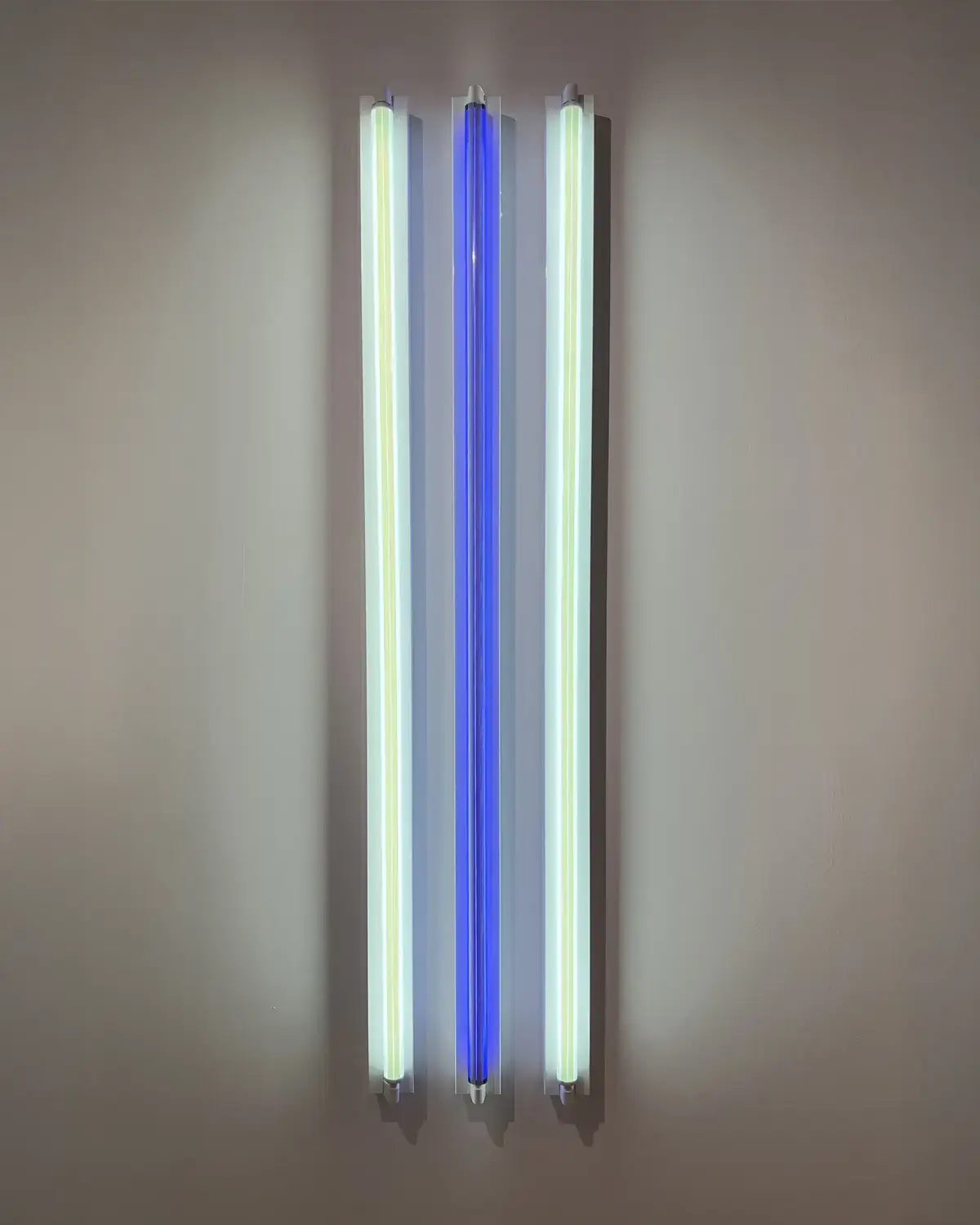
Robert Irwin’s fluorescent installations, like much of the art that emerged from the Light and Space movement with which he is associated, often demonstrate to the viewer how his or her perception operates. These works are designed to produce very specific visual effects, drawing one’s attention to how sources of light act and interact, and how the color and opacity of objects can be transformed by the presence or absence of light. In studying them, we experience the sensitivity and mutability of our own sight. This work is comprised of three six-foot tall fluorescent tubes layered with colored gels, emitting lights at various levels of brightness, obscured in places by strips of electrical tape or, sometimes, turned off altogether. Unique to each sculpture in this series, the resulting hues and intensities consider juxtaposition and sequence, but also the visual interplay of color and light. ‘The thing to realize is that the reduction was a reduction of imagery to get at physicality,’ Irwin has said, ‘a reduction of metaphor to get at presence.’ As Irwin explained, the work has 4 possible modes of display, which he called “flips”, all equally important to the perceptive potential of the work: no lights on; the two side lights on; the center light on; or all three lights on. The bulbs therefore have independent power switches, allowing them to be illuminated in different configurations that dramatically alter their appearance. For example, turning off the outer tubes causes them to turn a reflective frosted blue, while the inner tube conveys a deep violet. In his later exploration of such works as “presence” rather than “object,” Irwin produced them as “unlights,” where there is no illumination of the bulbs at all and where spaces between the fixtures are painted in varied shades of gray, destabilizing the boundaries of figure and ground and likewise dissolving the border between object and environment.