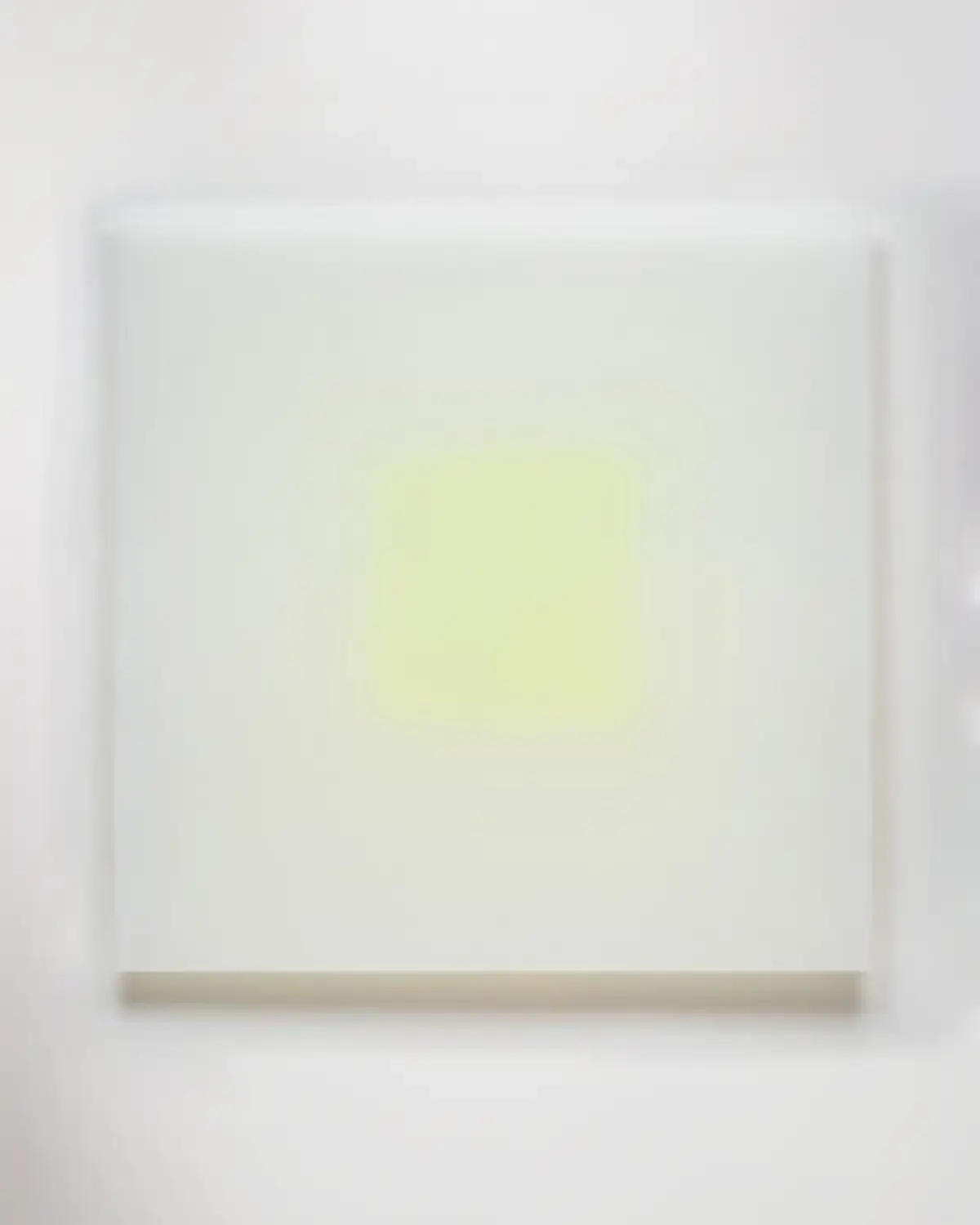
Peter Alexander was a principal member of the Light & Space group and like a number of his fellow SoCal artists in the 1960’s, he utilized resin as an artistic material. The legend goes that he had poured resin into a Dixie Cup to seal his surfboard, but found that over time the resin hardened into a translucent circle. This realization heralded the creation of Alexander’s iconic polyester resin sculptures. The negative part of the story, of course, is that polyester resin is highly toxic and Alexander, like others in the group (e.g., De Wain Valentine) suffered long term pulmonary injuries as a result of its usage. Alexander’s particular legacy, at the same time, is a body of often mysteriously evocative work, such as this piece, where color is suffused within the work creating a luminous effect extending beyond the sculpture itself as one interacts with it. Not surprisingly, Alexander maintained a deep interest in the work of Dutch Golden Age painter Johannes Vermeer, particularly his ability to embed his works with “that certain quality of light, that quality of being under water.” Mark Rothko’s approach to color and mark making also served as a cornerstone for Alexander’s practice. As he once said, “I’ve always loved Rothko and the sensibility [within the edges he creates], so I decided to cast objects that had those kinds of edges that disappeared”. And this sensibility can be seen in the translucently meditative sculptures for which Alexander remains best known.