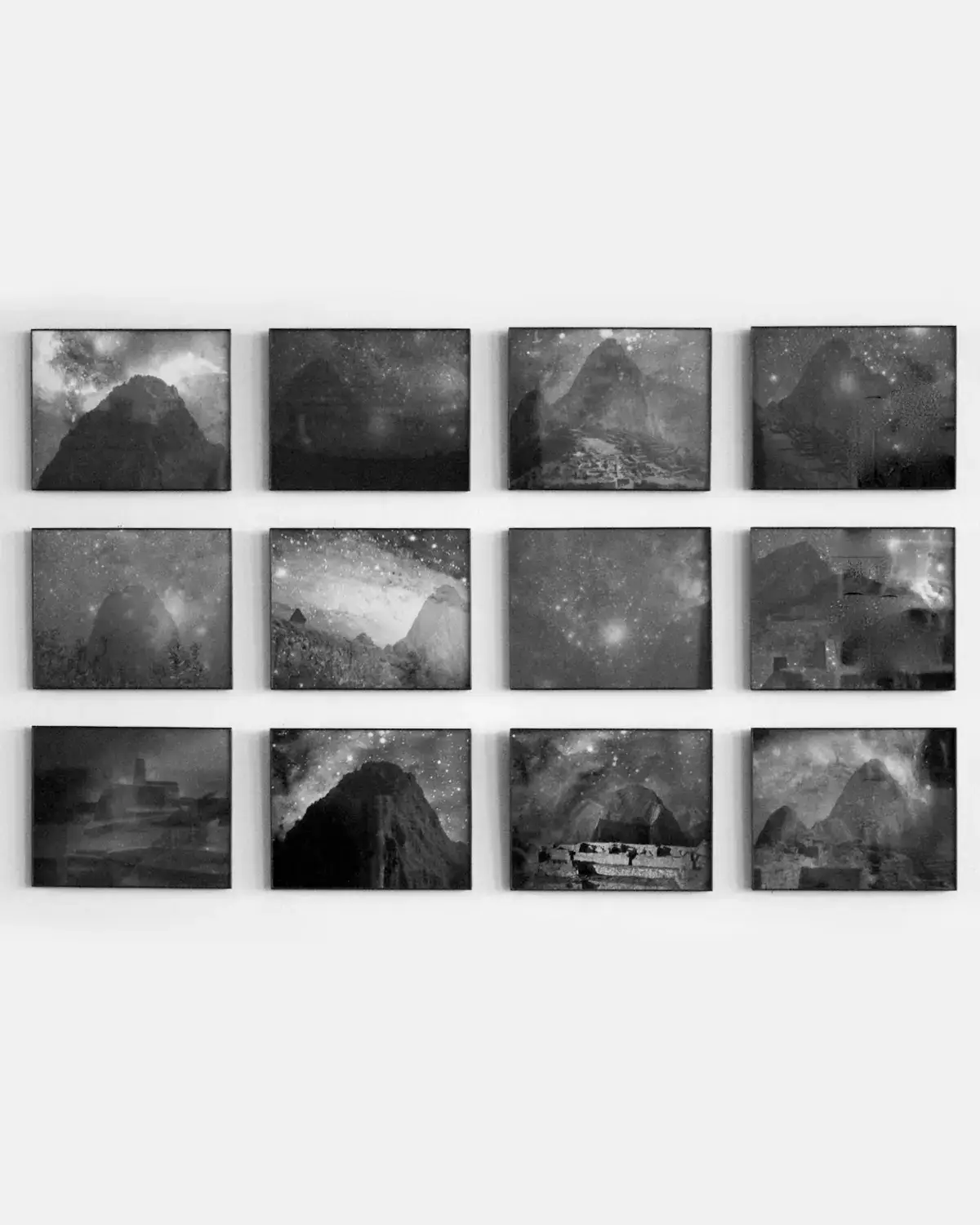
Where Stuart’s earth works involve direct physical contact with a site, the Rio Urubamba photographs (twelve archival inkjet images constituting a single work) represent her documentary practice, in which photographic sequences become as much a meditation on time as on place. The Urubamba River in Peru flows through the Sacred Valley of the Incas, past Machu Picchu, through a corridor of archaeological and cosmological significance to Andean civilization. Stars over this particular river constitute a subject in which the astronomical, the archaeological, and the natural converge. The work’s twelve-part structure introduces temporal rhythm: twelve photographs suggest both the months of the year and the hours of the night, positioning the work in relation to cyclical time as much as to the linear time of photographic exposure, the sequence thus read as a continuous field rather than as twelve discrete images.