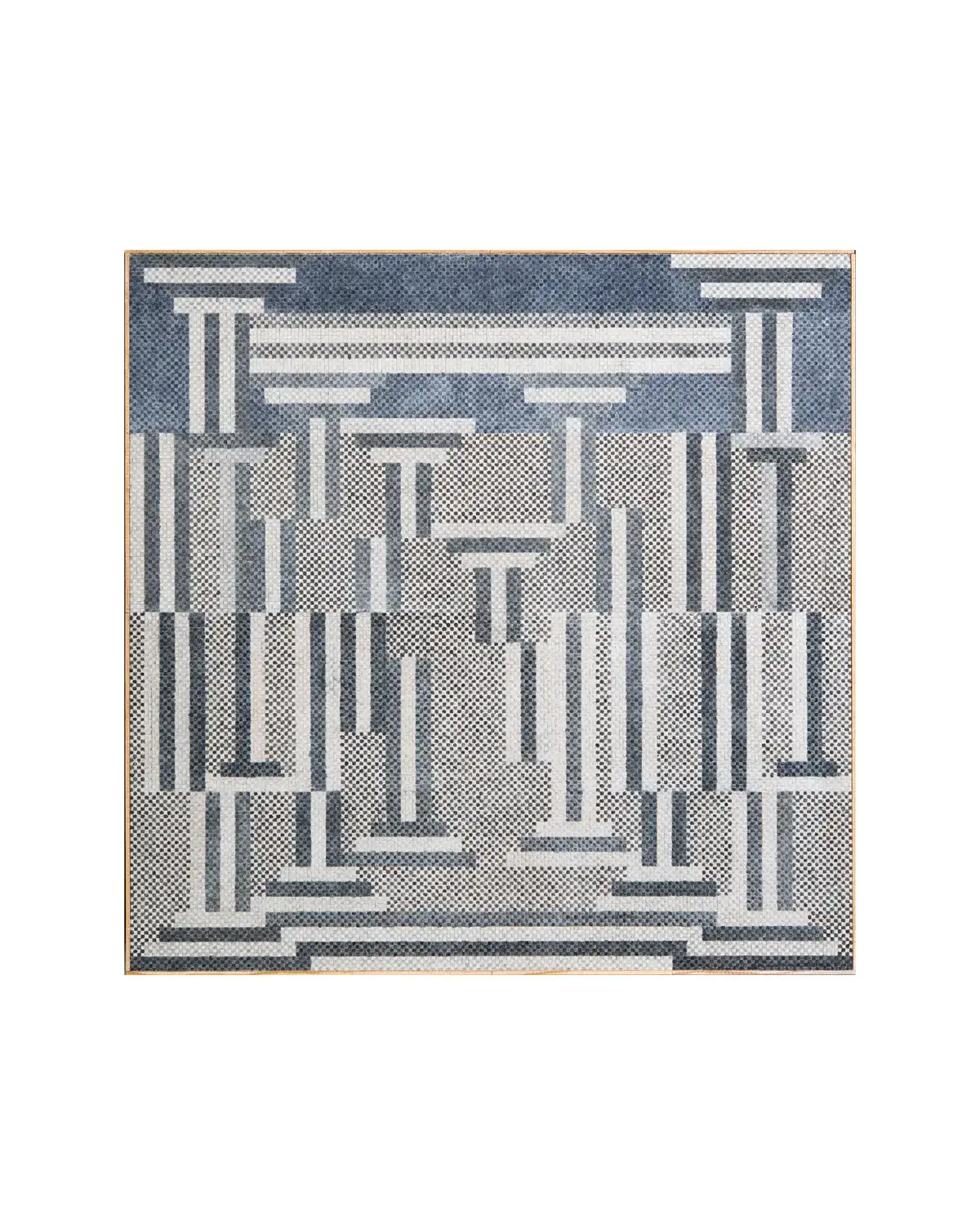
Joe Zucker’s “Empire Descending a Staircase” series was exhibited at the Mary Boone Gallery in 2013. The series featured paintings of various historical empires, created with the artist’s signature method of using watercolor and gypsum to form images on a scored grid, the top layer having been flaked off to create an irregular, porous surface that absorbed watercolor. The series included paintings depicting historical empires such as the Russian, Mughal (this example), British, Achaemenid, Mongol, Medo-Persian, and Ottoman Empires. Writing in The Brooklyn Rail, Alex Bacon noted that “these works are formally seductive in their curious manipulation of pictorial space. Zucker limited himself to a spectrum of black and white, with a few small coloristic digressions. By aligning this tonal spectrum with an underlying grid, Zucker eschews chiaroscuro—the traditional language of three-dimensional depiction and instead floats the shaded squares ambiguously on a ground. In our current moment, this technique can only be characterized as pixilated. The same might be said for the columns themselves, revealing a singular logic of pixilation that has been uniformly applied to the entirety of the painted field.
“The choice of columns as subject matter evokes, in a generalized way, the 18th Century vogue for the ruins of some of the empires mentioned in the titles of the individual paintings, such as the Medo-Persian or British Empires. However, none of the paintings are specifically referential. Instead, it is as if Zucker had pulverized the sublime perspectival depth of those 18th century landscapes and, via pixelated mediation, spread it evenly over the surface of the gypsum board. Most all of the expected indicators of pictorial space have been confused and reshuffled by the alien (because fully automatized and systematic) logic of pixilation. The size of one form versus another, passages of dark versus light, and shading more broadly, are, in the manic insistence of pixilation on democratizing the image, no longer always tied to the usual hierarchies that give them aesthetic meaning.”