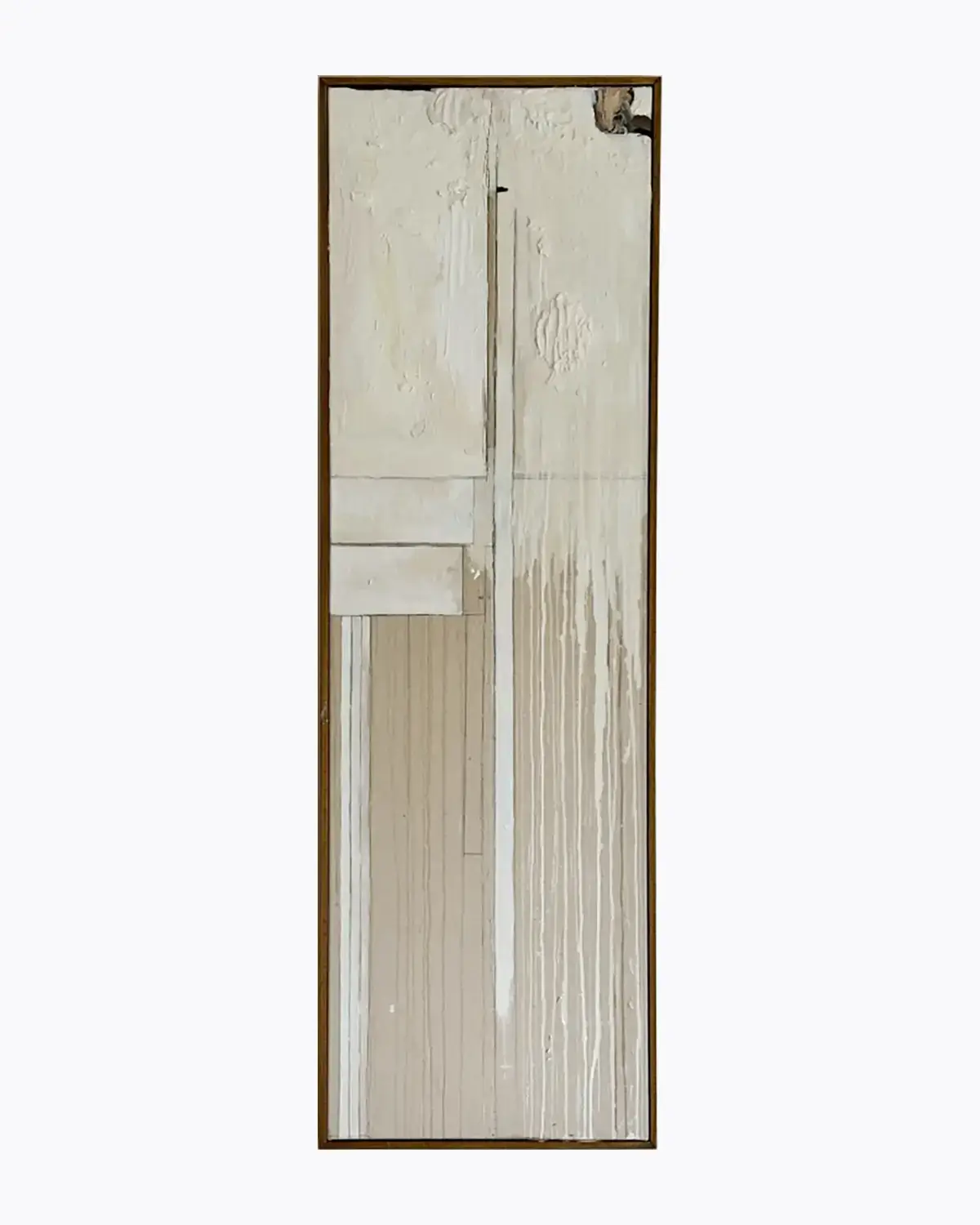
This painting was made to approximate the artist’s own proportions in two dimensions: a celebration of what it is to exist as a corporeal self — a body animated by a mind, yet confined by physical, psychological, and existential limits.
Wooller has divided the surface into a skeletal structure, mapping out zones of perception, emotion, and reproduction: eyes, heart, womb. Yet underpinning this figurative anatomy is an architectural logic. A horizontal datum line runs through the work — a reference point used in architectural and technical drawing to align imagined space. Here, it marks a division between zones of control and surrender: above it, painterly gestures are intentional; below it, the painting becomes reactive — with drips, bleeds and gestures drawn downward by gravity, echoing the tension between action and consequence.
The steps motif offers an invitation — a visual entry point — while the columns to the left recall Wooller’s sculptural language and her fascination with classical architecture. Their presence alludes to perspective, perception, and the fragile balance between how we are seen and how we experience ourselves. One acts almost as a compositional spine. Painted shortly after returning from Athens, the piece absorbs the political and symbolic power of the Parthenon — and the influence of built environments on human behaviour.
The materials — oil, house paint, plaster, marble dust — are layered and buried like skin. Wooller worked on the canvas from multiple positions: flat, upright, tilted. Paint was applied with brushes, rollers, and bare hands. The resulting surface is built up through repetition and erasure, concealment and exposure — echoing the process she developed in Not The Shower Room and her sculptural cast blocks: units shaped by time, material variation, and intention.
The frame contains it all — body, time, impulse — just as we attempt to contain and define ourselves.