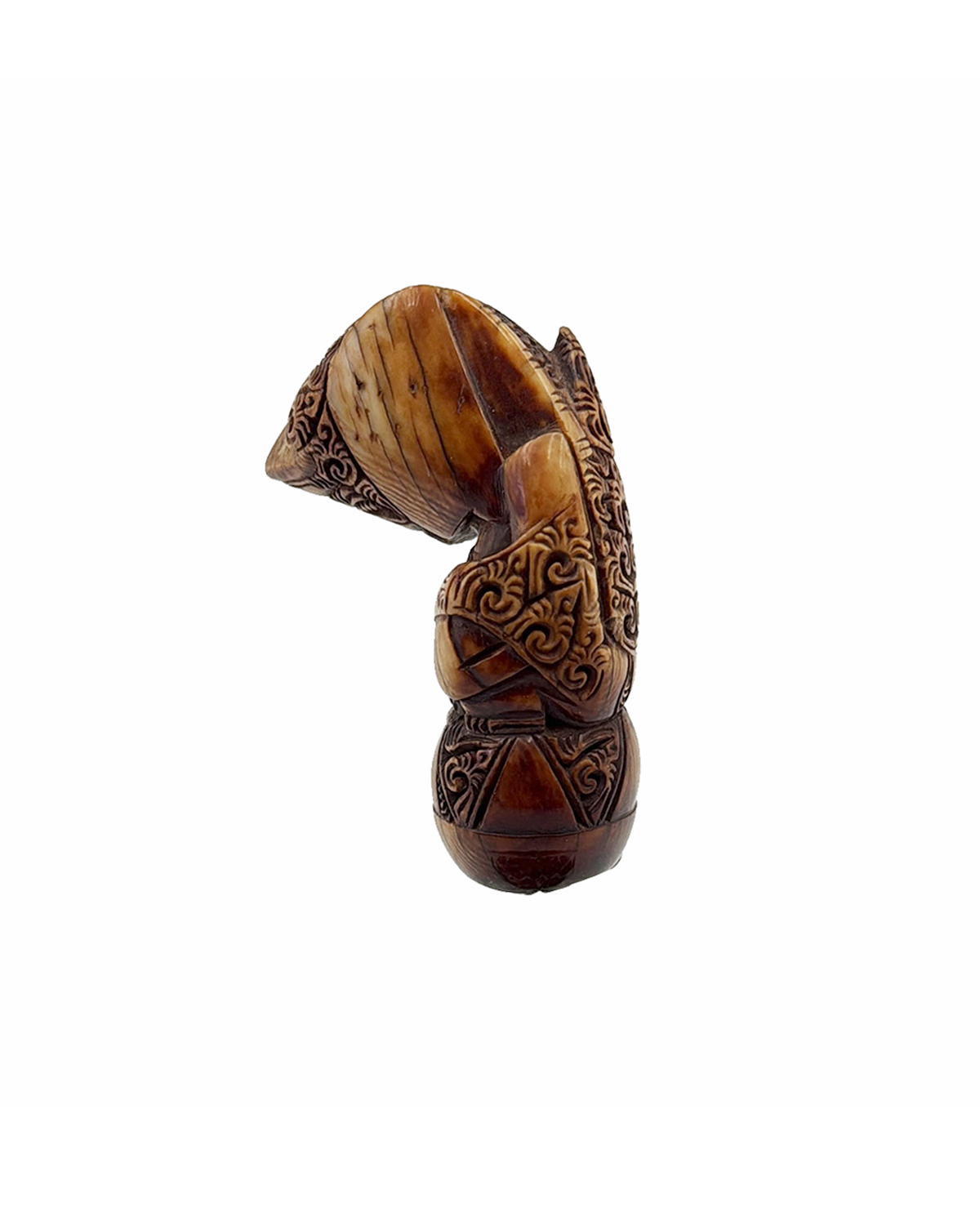
This hilt introduces an important intermediate category between the plain-material hilts (H01, H10) and the fully elaborated figural and ornamental groups. The material is amber-brown with darker natural figuring and some internal layering visible, consistent with a dense animal horn (possibly water buffalo or carabao) or a heavily pigmented bone. The form is a standard recurved pistol-grip, somewhat larger and more broadly proportioned than the Javanese norm.
The ornament is concentrated in two registers. The main body of the hilt carries a dense low-relief carved program of kala-derived spiral and volute forms, the surfaces worked with tight interlocking curves that fill every available space without a central figural axis. The mendak-base area carries its own carved register of triangular and geometric elements with spiral corner fills. This combination of kala-spiral vocabulary with geometric base ornament is documented in both West Javanese and Sumatran hilt production, where the decorative language bridges the figural kala tradition of Bali and Java and the non-figural arabesque tradition of the Malay Peninsula. The hilt therefore strengthens the argument for the importance of the Sumatran and West Javanese traditions as transmission zones between the Hindu-Buddhist east and the Islamicized northwest.
Mendak (pronounced men-DAHK)
The collar or spacer ring fitted between the base of the hilt (ukiran) and the ganja of the blade, serving both a structural and a decorative function. The mendak is typically of metal (brass, silver, or gold in high-quality examples) and is often the most finely worked metalwork element of the hilt assembly.