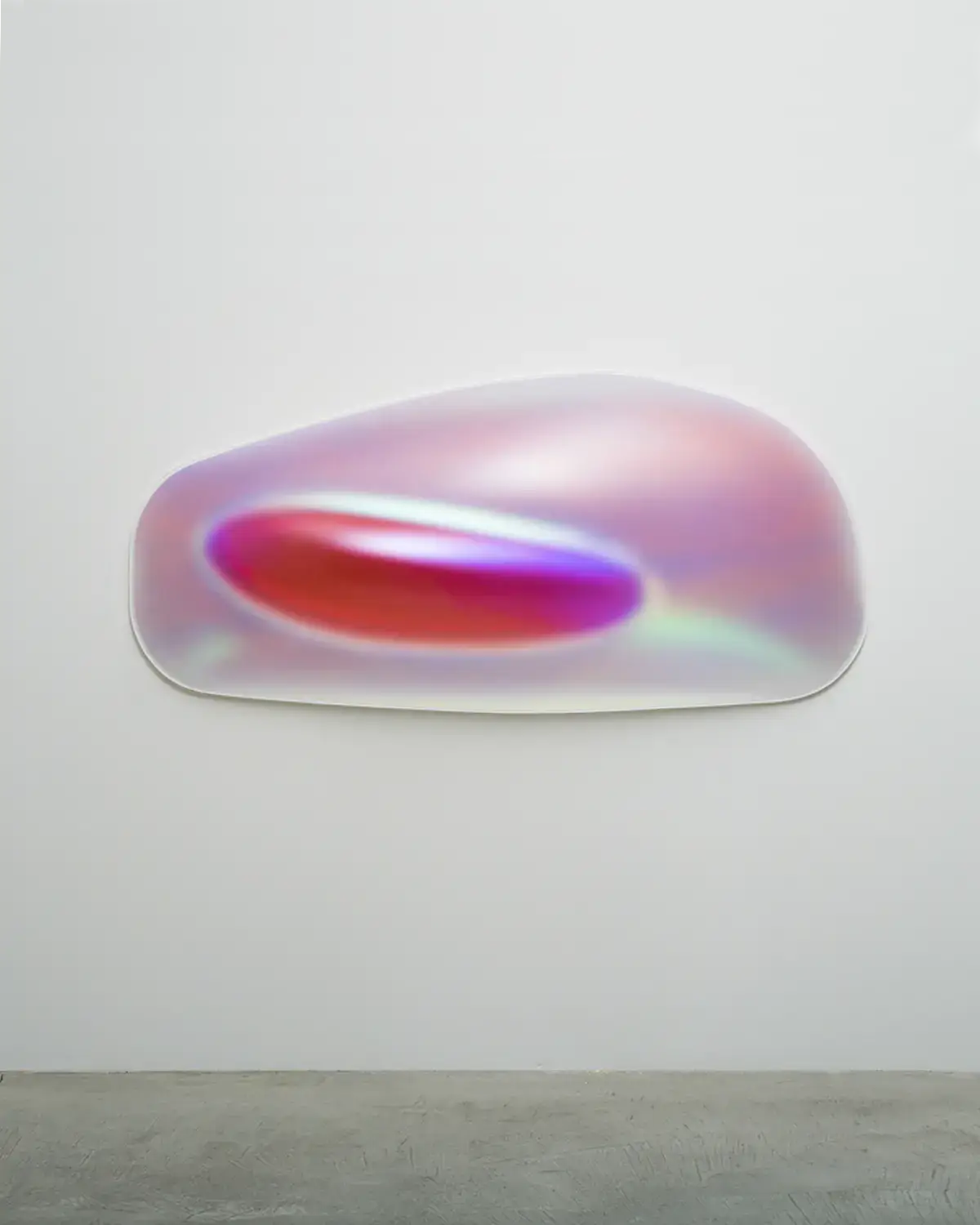
Colón’s Glo-Pods belong to a practice that she describes in terms of post-minimalist phenomenology as works made from industrial materials (blow-molded acrylic, the same process that produces consumer plastic packaging) that exploit the optical properties of their material rather than concealing them. The iridescent acrylic surface of this work thus shifts in color across the visible spectrum as the viewer’s position changes. What appears red at one angle becomes orange, then gold, then green, creating an experience of color that arises out of shifts in the viewer’s movement and perspective, enlivening the visual potential of the object itself. The ellipsoidal form of this work is organized around a central axis that both flattens the object against the wall and insists on its volumetric presence. Colón’s work thus builds on the material and perceptual concerns of the pioneering generation of California Light and Space artists such as Helen Pashgian, Mary Corse and De Wain Valentine, whose works the Aardt Foundation also holds in depth.