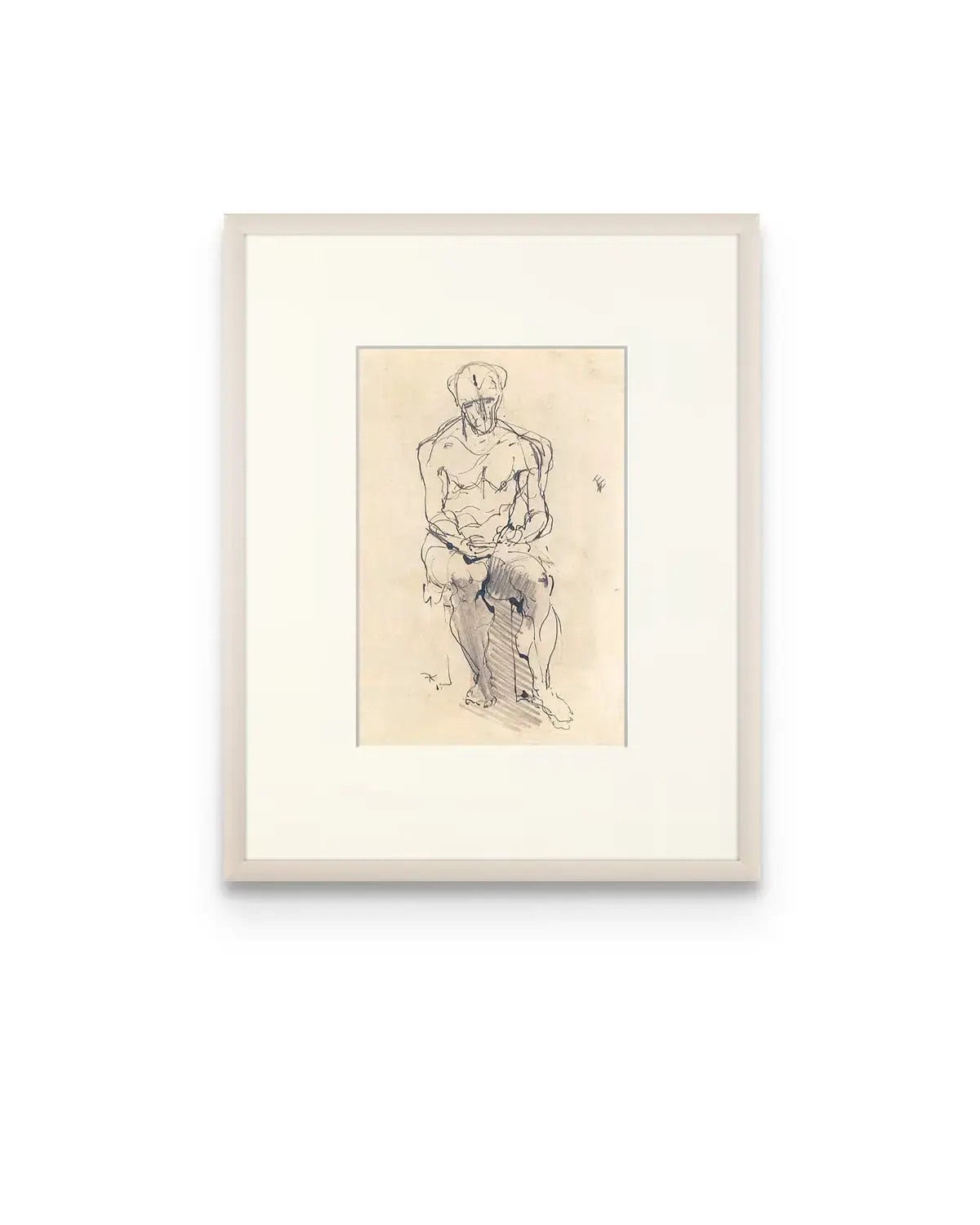
This ink and graphite nude self-portrait predates by over a decade the gestural black-and-white abstractions for which Kline became famous, the monumental brushstroke paintings that appeared after approximately 1949, when, according to a famous account, Kline used a projector to enlarge one of his smaller drawings and discovered the power of the scaled-up gestural mark. In 1938 Kline was still a young figurative painter working in a broadly Ashcan tradition, skilled but not yet the pioneering artist he would become. A nude self-portrait is an act of almost clinical self-examination — the artist as his own model, the body scrutinized without the social or symbolic overlay that the clothed figure carries. So while Kline’s mature abstractions have often been described as architectural and urban, responding to the girders and bridges of the industrial landscape; but they may also be read, in retrospect, as bodies — torsos, limbs, the pressures of a figure against a ground — and this early drawing might offer some biographical evidence for that reading.