
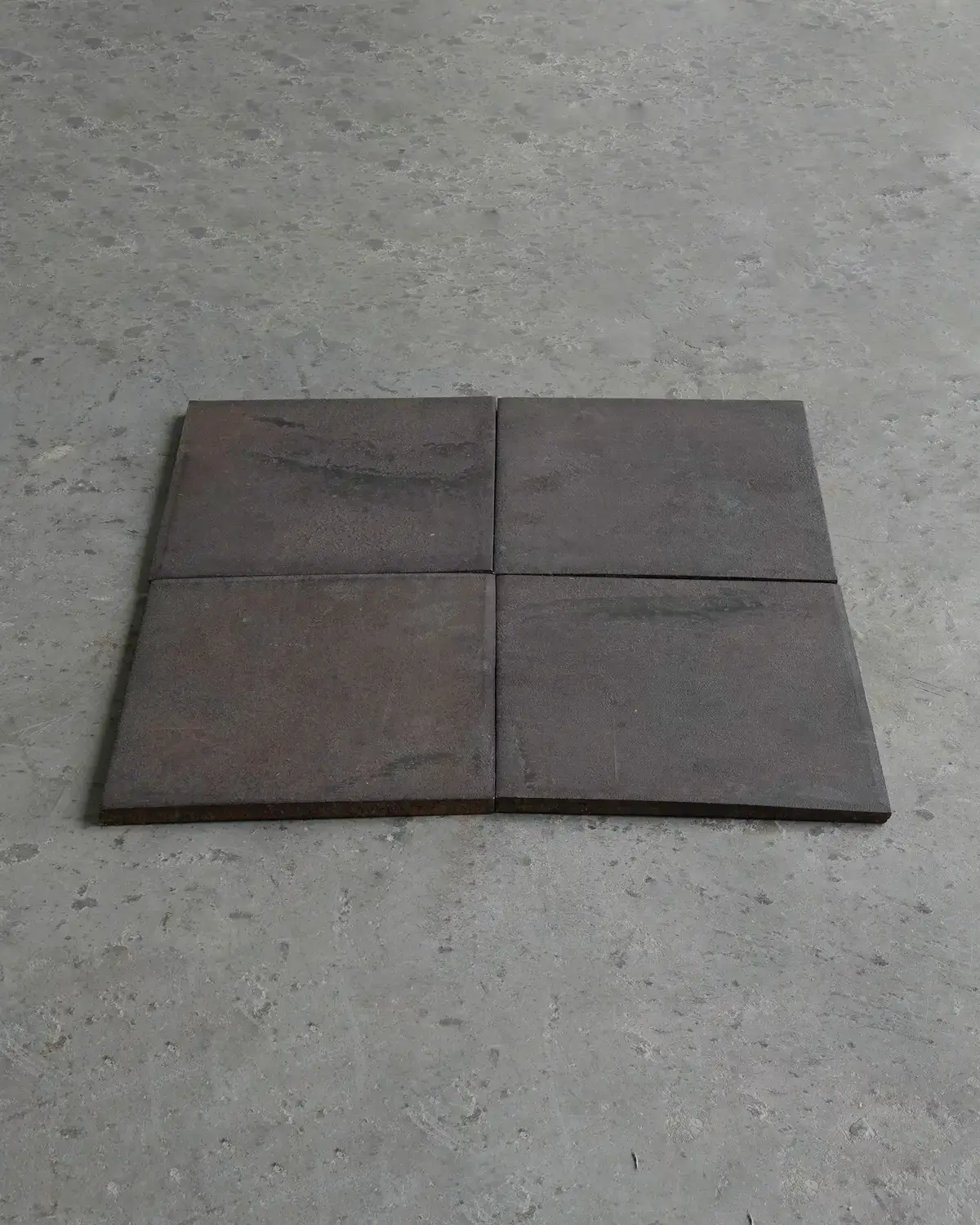
This early floor sculpture is among André’s first involving steel plates, with its square configuration becoming something of a signature form for him. See for example the National Gallery of Art’s related 64 Steel Square. The blunt, arithmetical logic of the work is underscored by the conspicuous absence of the artist’s hand: it is not carved or welded or, in some overtly skillful way, shaped. Instead, the elements are simply arranged in a format which reiterates the shape of its modular components. Those parts themselves were obtained from an industrial scrap yard. The plates are not perfectly square, however, nor are they free of rust, scratches or other imperfections, but rather retain their “found” origin. It is unclear from the installation instructions in the accompanying certificate whether they can or even should remain free of internal relationships, as is the case with other of André’s works comprised of essentially interchangeable elements, such as 64 ACE Zinc or AL Pararange, both also in the foundation’s collection. Instead, the authenticating certificate simply reads, “4 unit square (2 x 2), on floor.” Andre therefore did not require a specific configuration (e.g., with the respective elements to be placed at a specific position rotationally or otherwise in relation to the others, apart from forming a square). And because of the slight irregularities in the elements as they were left in the scrap yard, there are in fact only a couple of ways in which they can be fitted together so as to minimize the gaps between them. It therefore is likely (although now unverifiable) that the artist did not intend that the elements be arranged as much as possible in a gap-free composition. It is enough that the plates are merely put on the floor, one next to another, in repetitious sequence. The work itself has an interesting provenance, in that it was first acquired by Brice Marden in a trade with Andre for one of Marden’s paintings. André donated that painting to the Addison Gallery, while Marden sold this sculpture through Pace Gallery to Virginia and Herbert Lust, from whence it ultimately came into the foundation’s possession some decades later.