
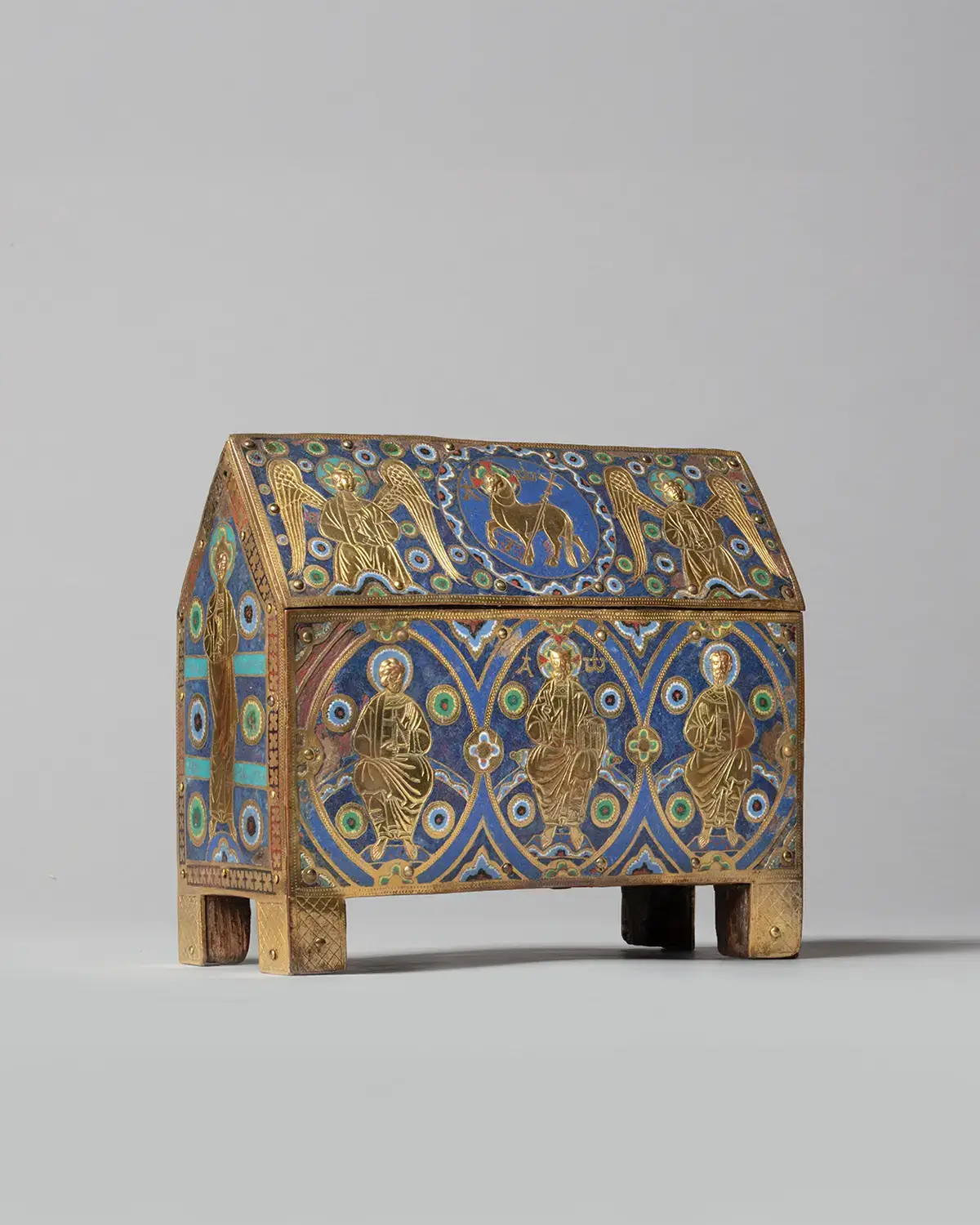
This grand reliquary chasse was made by master Limousin metalworkers in the years around 1200. Its oak core is covered with four fully-gilded copper plaques enameled with the figures of Christ in Majesty surrounded by saints, and constructed in the shape of a building with a pitched roof and an opening in the lower panel of the reverse face. As with most Limousin chasses, the largest enameled panel is the lower of the two decorating the front of the casket, which is divided into a tripartite composition by three mandorlas (oval vignettes), framed in blue against a deeper blue backdrop. In the central mandorla Christ sits on a fine multicolored arc decorated with undulating bands of enamel, with his feet on a speckled footrest and the two ends of a richly upholstered cushion visible at his sides. He wears a crown and a full-length garment beneath a mantle wrapped over his shoulders. His right hand is raised in the sign of the Benediction, and in his left hand he holds a large bound book, signifying the Word of God. He is flanked on either side by bearded male saints (likely representing Apostles or Evangelists), both of whom sit on similarly decorated arcs and hold books in their hands.
Large flowerhead-like rosettes with radiating rings of colored enamel punctuate the dark blue backdrops around each of the three figures, while the spandrels between and around the three mandorlas are punctuated by stylized petal sprays. The same palette of colors and forms of decoration also cover the upper plaque above, which is decorated with three-quarter length figures of angels appearing on either side of a central circular vignette in which the Lamb of God is shown accompanied by its typical attributes of a book and cross staff. On either side of the Lamb’s haloed head, and of that of Christ in the plaque below it, the letters Д and Ѡ, which stand for Alpha and Omega, are picked out in gold. The gabled plaques at either end of the chasse are decorated with standing saints (perhaps Apostles) framed by a diaper-patterned border design in red and black. Although their plaques are also decorated with horizontal bands of a light blue enamel, the rosette motifs peppering their backdrops are identical in treatment and style to those of the two plaques on the front of the chasse. An incised gridwork pattern decorates the gilded metal covering each of the object’s four feet.
This is one of those objects where the provenance is of particular interest even though — as is nearly always the case with objects of this antiquity — there is a gap of some hundreds of years when its location and ownership are unknown (although as religious objects might be presumed to be those of a church, private devotional setting, monastery/convent, or the like). In all events, following a series of sales in the late 19th and early 20th century, the chasse was acquired by the German industrialist Fritz Thyssen in 1938. It was then confiscated from him by the Nazis in 1939 when he turned publicly against Hitler as a protest against the Kristallnacht persecution of the Jews, this being despite having been one of Hitler’s early supporters and indeed one of the regime’s key financiers. That opposition also led to his arrest in 1941 and confinement in a series of concentration camps. While Thyssen survived the War, he was later fined 15% of his assets by a denazification tribunal, with the funds to be paid as compensation to those who suffered as a result of his early support of the Nazis. The chasse itself was stored throughout the War at the Folkwang Museum in Essen. It was recovered by the Allies in 1945, and restituted to the Thyssens by the British administration in 1949. It then passed by descent until sold by the family in 2025.