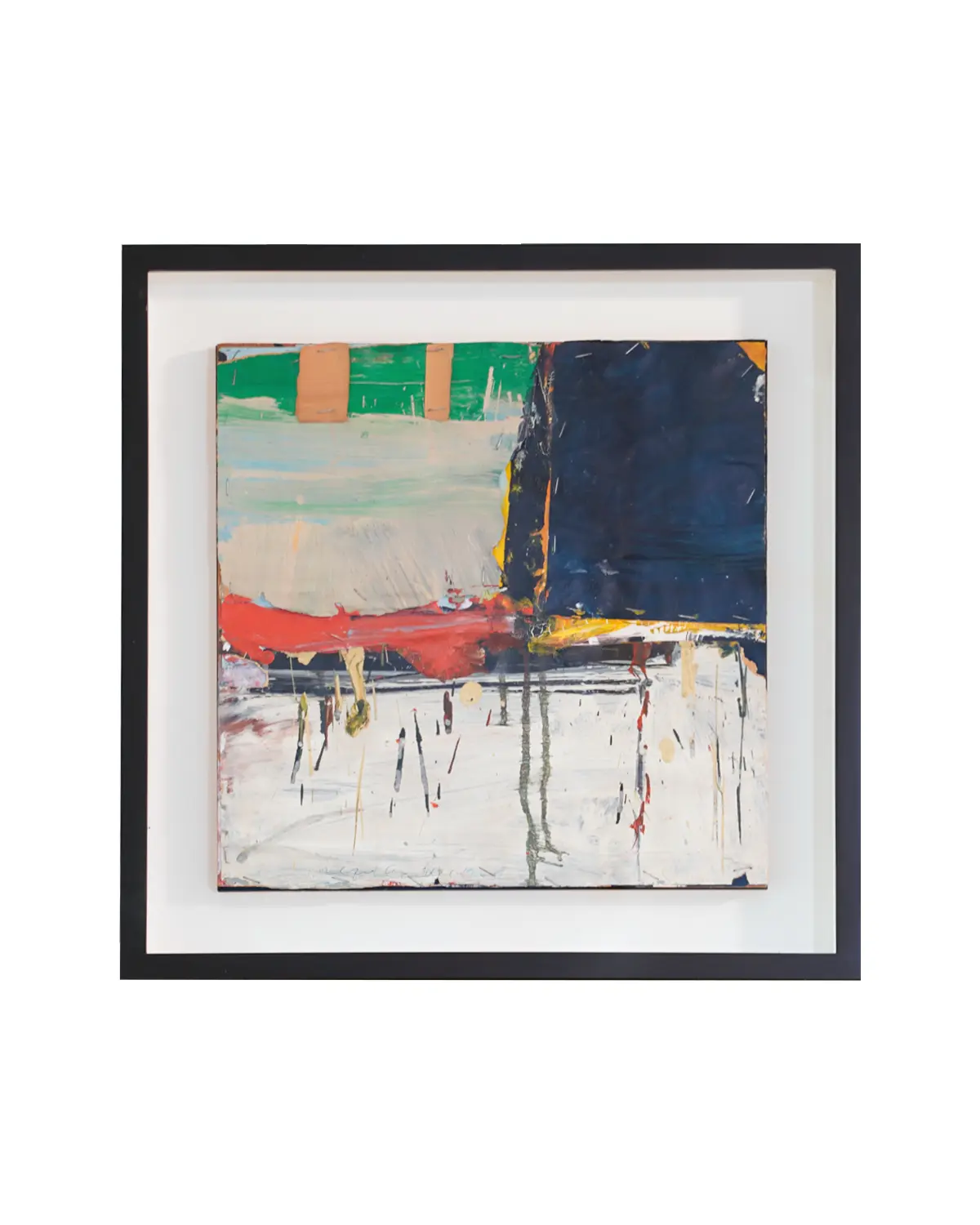
Leslie’s early work, from 1951, when he was 24, into 1962, is typified by small painting-collages in which torn and cut shapes of black and white painted paper are stapled to a surface that is already painted with splatters and configurations like the vertical bars that are a constant motif in all this early work. The picture plane is appropriated even more insistently and literally than in the work of his older Abstract Expressionist contemporaries. As much as the shapes order, they disorder, clashing with one another, partly covering up what is underneath, leaving raw spaces where their rough edges almost conjoin. The rectangle of the picture is powerfully gripped in structure, precisely because nothing fits neatly together; everything intrudes on everything else, laterally and in depth. This collage dates just before Leslie’s turn toward the confrontational photo-realist figuration that became his mature style. The work was untitled at the time of its acquisition by Aardt’s founder. When Leslie saw the work on a visit to Birmingham, Alabama and learned that it had been sold as “Untitled,” he said that it was in fact his practice to name such works after the owner, hence he christened it on the spot as “Michael’s Collage.”