
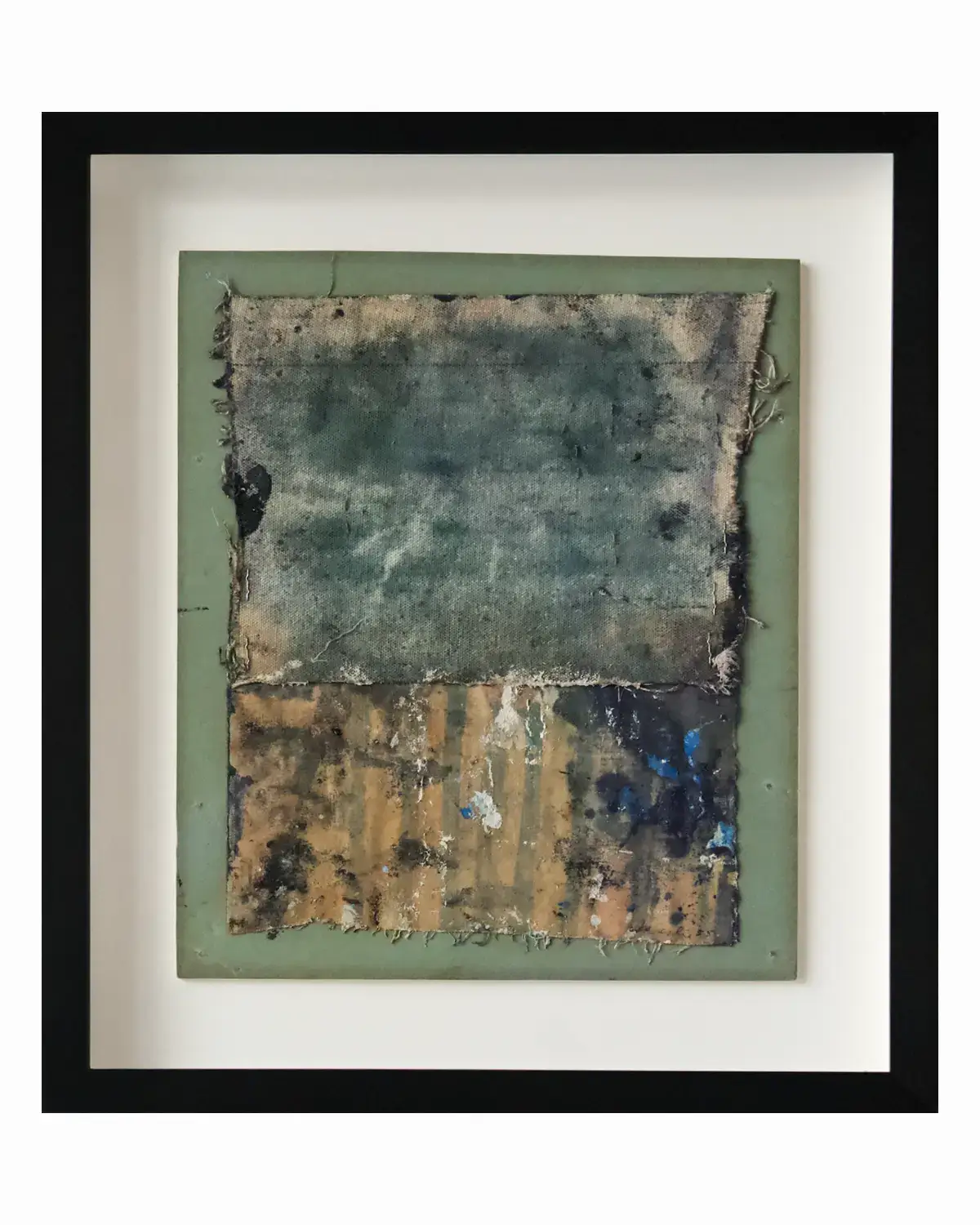
This collage from the mid-1950’s builds on American flag imagery earlier found in A Survivor, a 1951 painting of Leslie’s gifted by Aardt’s founder to the Birmingham Museum of Art “in honor of the victims and heroes of September 11, 2001” (see Gifts and Loans). Before that, flag imagery had previously been seen in less abstracted and often lyrical works, often with themes of valor and victory, as in Emanuel Leutze’s 1851 Washington Crossing the Delaware, as well as in exuberant works such as those of Childe Hassam. Leslie’s collage here (like his earlier painting) is thus more disordered and disturbing. Compare also Jasper Johns’, 1954-55 Flag in this context, with its challenge to the meaning of flag imagery in our culture.
Leslie himself was a master of collage. It is worth noting the fragility of the work, which consists of fabric, oil paint, staples and nail on cardboard with a green paper skin. Works of this sort must therefore often be conserved in order to preserve and protect them against deterioration over time and conservation efforts are an important responsibility of sound collection management. And good conservation requires great technical knowledge, care and skill, as shown in this report by paper conservator Daria Keynan:
-Surface cleaned recto and verso using crumbled vinyl erasers, non–latex make-up sponges and chemical sponges.
-Removed nails holding art to frame and to wood strips.
-Removed wood strips from nails on back of work.
-The nails used to attach the art to the wood strips were long and rather rusty.
-It did not seem logical to create a mount deep enough to support the full length of the nails so the following treatment was carried out:
-The nails were pushed up and out of the front.
-They were cleaned of dirt and rust using acetone.
-They were coated with B72 in Toluene.
-An 8 ply board with calcium reserve was placed behind the collage and holes were made in it to correspond to the original nail holes.
-The holes in the green board were sized with methyl cellulose.
-The holes were filled with paper powder in methyl cellulose. As this mixture dried, the nails were coated lightly with Lascaux 498 20X and inserted back into the holes.
-After drying the part of the nails which protruded beyond, the 8 ply mount was cut and a small patch of Japanese paper placed over the verso hole to further strengthen the area.
-Bits of the paper powder fill which showed around the nails were tinted to match the green board using watercolors and pastel pencils.