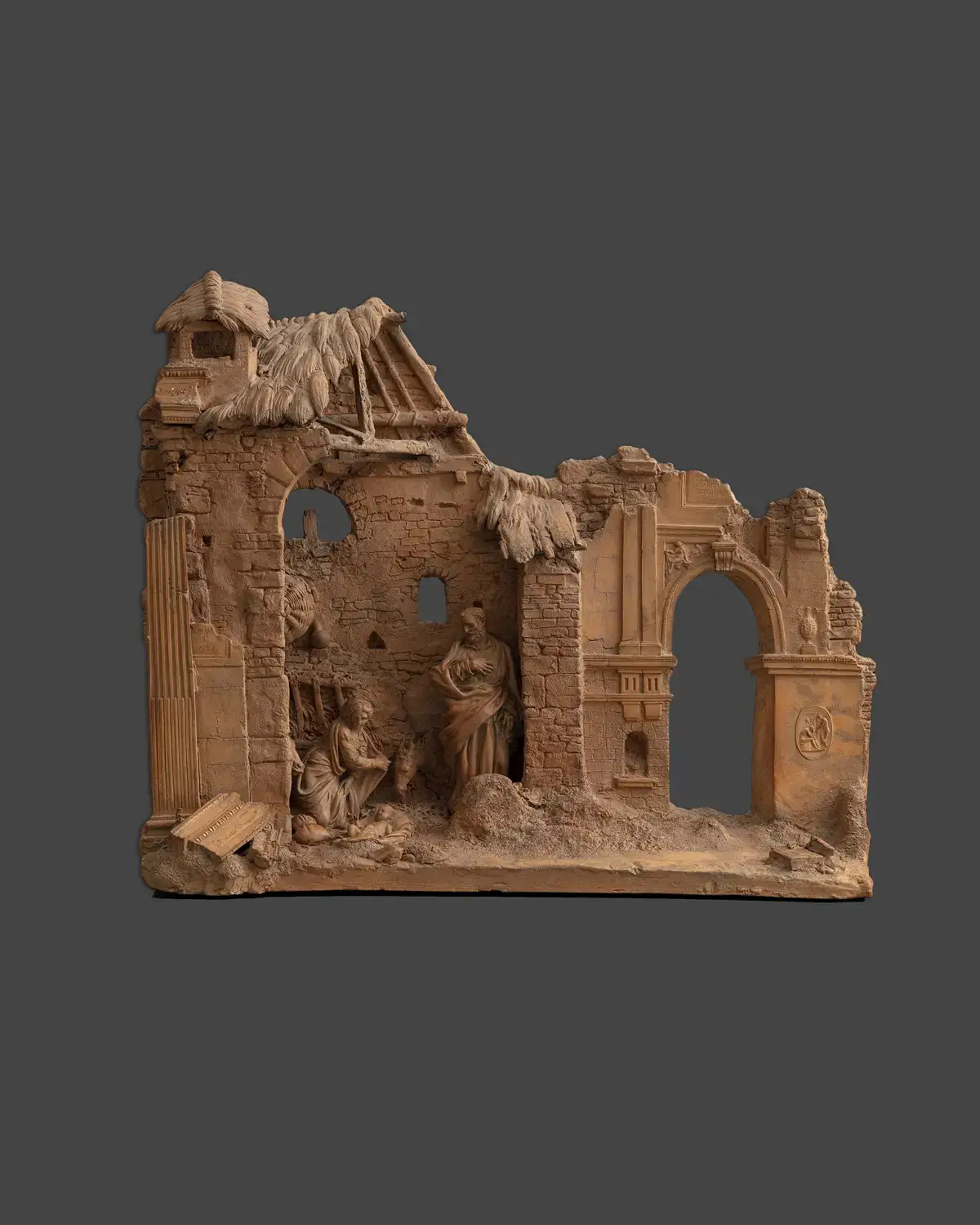
The Neapolitan presepe — an elaborate Christmas crèche — was by the latter eighteenth century the dominant sculptural art form in southern Italy and an industry sustained by specialist artisans who produced figures in terracotta, wood, and papier-mâché for commissions ranging from royal palaces to domestic chapels. Broglio worked within this tradition, producing terracotta Nativity groupings of a quality and refinement that distinguished them from the purely craft production that supplied popular demand. The medium itself has significance: terracotta (fired clay without glaze) is among the oldest sculptural materials in the Western tradition, predating bronze and marble in the archaeological record, and its earthen warmth carries connotations of the incarnate and the domestic entirely appropriate to the Nativity subject, presented here in a landscape of ruins. St Joseph, the Virgin and Child are depicted entirely in the round while only the heads of the ox and of the donkey are represented. Their direct surrounding is a ruined thatched stable, the rusticity of which is underlined by the presence of rural tools. The stable is inscribed in a more noble décor of Roman antique ruins depicting a fluted pilaster, a piece of architrave and an arch adorned with delicate medallions.