
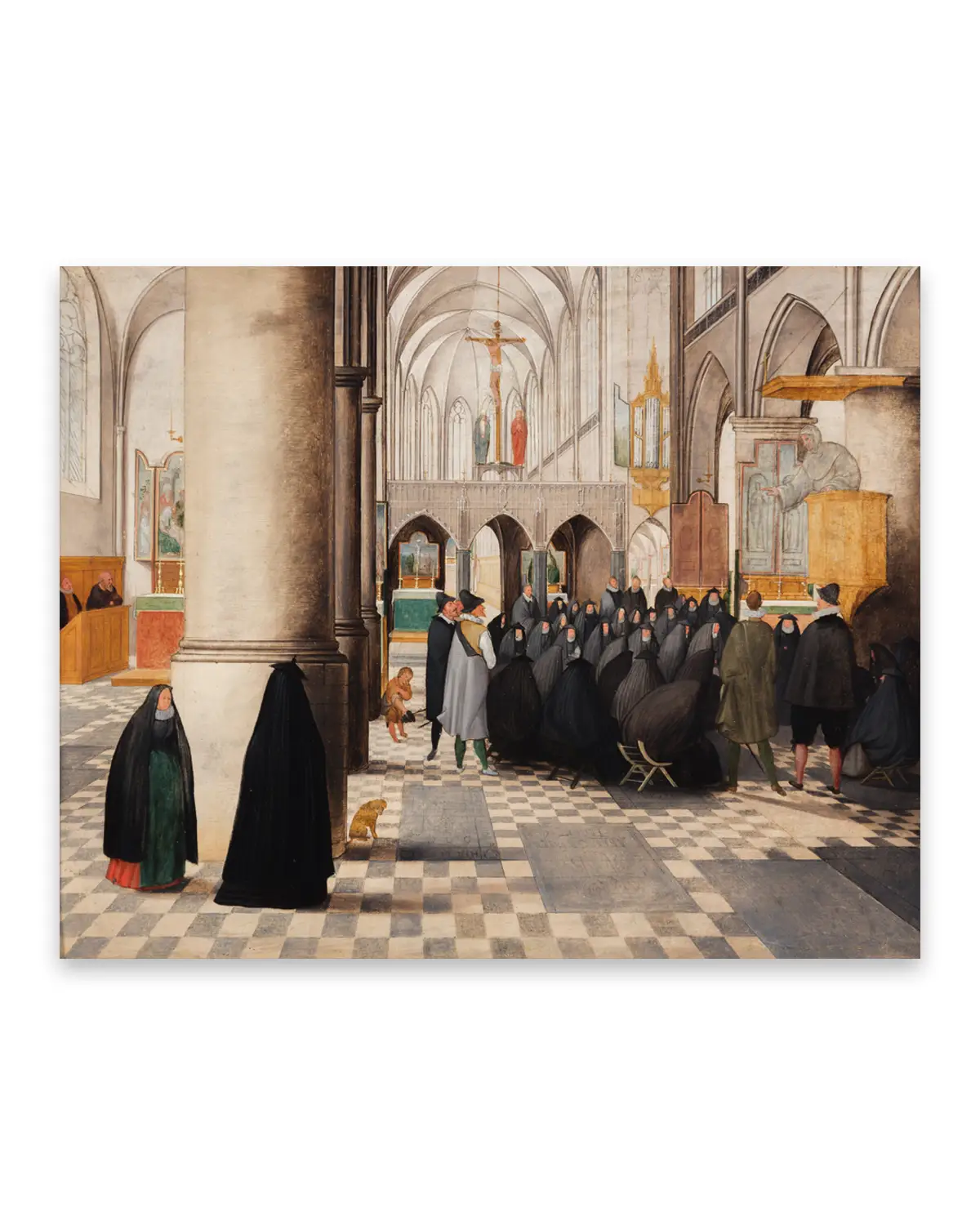
The architecture in the present painting appears to be the artist’s own invention. Grimmer used a strict perspective with a vanishing point at the main altar. A variety of triptychs are spread throughout the church, illustrating major events in the life of Christ. The floor’s strict geometric design is broken up by an irregular pattern of gravestones. During a sermon a priest stands on a pulpit while preaching to a group gathered underneath him. Two cloaked woman shuffle towards him from the left foreground. The interior is seen from the North entrance, looking towards the East end. As in his other church interiors, Grimmer has incorporated his signature as an inscription on one of them.
The painting’s provenance illustrates the importance of verifying prior ownership to the extent possible when acquiring older works. While nothing can be determined of its pre-20th century owners, it was sold at auction in Sweden in 1937 to an unnamed private collector and remained in that family until 2014, when sold again at auction, also in Sweden. The date is relevant because of Nazi-era sales by Jewish families under duress. In order to safeguard against the unwitting acquisition of such works – which are essentially, stolen property – before buying a work from that era one should obtain a certificate from the Art Loss Registry identifying the work and affirming that based on all available records it has not been reported as lost or stolen between 1933 and 1945. This painting is thus accompanied by such a certificate. To be sure, descendants of families whose works were stolen by the Nazis can be unaware of the same for years, given the absence of records and/or the death of the original owners. In this instance, the painting had been published for some decades and widely shown; coupled with its having been sold in Sweden and remained there through the war, it is highly unlikely to fall within that category. That said, should it later come to light that the painting was somehow acquired in a forced sale or otherwise falls within the category of stolen property, it would be restituted by the foundation to the rightful heirs. For such a circumstance, see the work by the Master of the Female Half-Lengths, a work in the foundation’s collection that was in fact acquired by way of restitution.